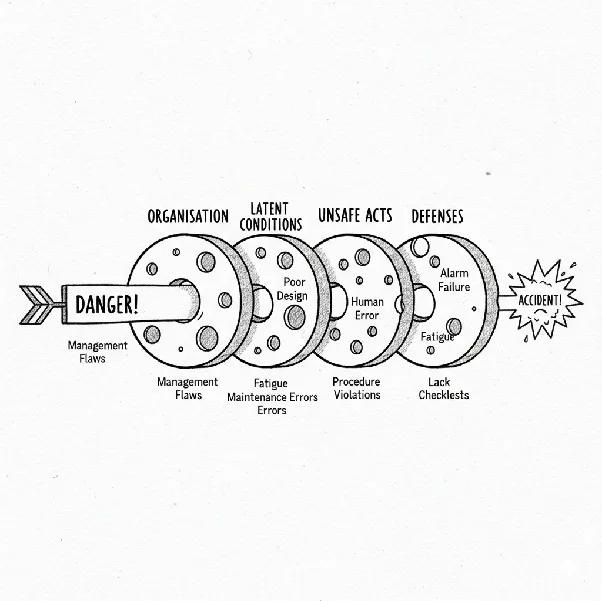
James Reason’s layered model, known as the “Swiss cheese” model (illustrative diagram)
At our own risk and peril?
This project is free of charge and openly licensed. This translation was produced by artificial intelligence. On such a technical subject, it is likely to contain major inconsistencies or mistranslations.
If you can translate the French more accurately and you know the language of the free-flying community, your help is very welcome to offer a better version. Contact Julien: j.garcia@ffvl.fr
© 2026 Julien Garcia.
This book is distributed free of charge under the Creative Commons Attribution – NonCommercial – NoDerivatives 4.0 International (CC BY-NC-ND 4.0) licence.
You may copy, print and share it freely, in any medium and in any format, on three conditions:
Full text of the licence: https://creativecommons.org/licenses/by-nc-nd/4.0/deed.en
This book was completed with the help of an artificial intelligence, which helped draft paragraphs following the author’s instructions, format the notes and make corrections. The ideas, the choices and any errors remain the author’s own.
For convenience, this book most often refers to the pilot as “he”. It is nonetheless meant for every pilot, whatever their gender.
Translation. This English edition is translated from the French original, Sécurité en parapente. À nos risques et périls ?. The translation was produced with the assistance of an artificial intelligence. Figures from the French federation (FFVL) and other sources are given exactly as in the original.
Translation reviewed by: [TRANSLATOR TO BE CREDITED]
Readers who spot an error or a clumsy turn of phrase are welcome to suggest a correction: https://github.com/julien66/pgsecurite
Legal deposit: November 2026
This book is not a flying manual. It will not teach you how to inflate a wing, how to core a thermal or how to clear a cravat. Excellent books already do that.
It is a look at our community and at the way it thinks about safety. I write it from where I stand as a pilot, as a national coach and as a federation accident investigator. I also write it as a friend of those who have fallen. I have the feeling that our community is on the wrong track. I want to share observations, hypotheses and proposals, in the hope that they will open the discussion and that, perhaps, our ways of thinking will change.
Some passages may offend. I am well aware of that. I did not write this book against pilots, instructors, organisers or institutions. I am fighting ideas that cost us lives and, tired of doing so on my own, I decided I had to make a book of it.
I hesitated, I took my time, but here it is. It goes to Benoit, Bram, Cécile, Dan, Daniel, Françoise, Franz, Innes, Jonathan, Marie-Christine, Mathias, Maud, Norman, Philippe, Rémi, Scotty, Stephan, Sylvain, Timo, Xavier, Yoann… It goes to those I have forgotten, from the height of my vanity and the lack of empathy that comes with 25 years of lucky flying. It goes to all the others, and to those who, sadly, will follow.
Paragliding, in the broad sense, brings its share of deaths and injuries. We are a small community, and a number of our friends lose their lives every year. As a tribute, I have named a few of those I met along the way. I will not single out any names, because there have been too many and my grief cannot be ranked. Yet I have lost count of the friends and loved ones. Worse, perhaps, I am surely forgetting some… Shame on me, you might think? Resilience takes whatever paths it must. Here the end justifies the means. What I cannot forget, on the other hand, are the three athletes from our federation’s performance programme lost within the space of a few years. Some of the circumstances were truly vile. Lives and families shattered, trauma in abundance, and great emptiness when evening comes.
We will soon bring out a few figures and talk statistics, but the accident rate of our activity, and of competition at international level, is not heading in the right direction. Despite this reality, which few dispute, our community remains relatively closed and abnormally resilient to the accidents our shared passion produces. Everyone finds their own way and handles their own grief. Most of those close to the victims choose to keep flying. Others stop in silence, and safety seems to barely change from one year to the next. I was the first to think that paragliding competition was a safe activity, and I often even said it was safer than traditional flying, in that it offered a more rigid framework that I considered effective and protective. Today I no longer think our activity is “safe”, neither in competition nor in leisure flying, and through these pages I want to invite us to take a hard look at ourselves in the mirror. First, I will set out the myths and mechanisms behind this surprising resilience of our community. Then I will propose concrete ways out of this status quo, without giving up what lies at the heart of free flight: its freedom. Competition, which I know closely, deserves a work of its own; it will be the subject of a second book.
Who today can say how many pilots have lost their lives paragliding? No one. Not the French Free Flight Federation, not the International Hang Gliding and Paragliding Commission, not the European Hang Gliding and Paragliding Union (EHPU), not a single manufacturer, insurer or researcher. After nearly forty years of flying, our community does not know how to count its dead. This is not a technical detail. It is, I believe, the first symptom of everything this book tries to describe.
The first to really try was not an institution. It was one man, and a controversial one. Rick Masters is a veteran American hang glider pilot. For years he has been recording paragliding deaths around the world from press reports, and he publishes his figures on his websites and his blog1.
His reasons are not mine. Rick Masters is convinced that the paraglider is flawed by design: a wing with no rigid structure, which can collapse and let its pilot fall. “It’s stupid to fly something that will do that,” he writes2. He contrasts the paraglider with the hang glider, which has a frame, and accuses the paragliding community of being in denial. His messages have often been received as provocations, his statistics disputed, and the man himself rejected3.
Years later, I have to admit that his main arguments make sense. Rick Masters describes the paraglider as a frameless aircraft, and he drew what he calls the Paraglider Dead Man’s Curve4: the band close to the ground where a collapse leaves no time either to recover the wing or to get a reserve open. On his diagram, the zone marked “AVOID” rises to more than a hundred metres for a simple collapse, and much higher for a spiral dive. In France in 2026, eight fatal accidents happened on cross-country flights after collapses close to the ground, with no reserve deployed: the pilots did not have time to throw it. One can reject Rick’s conclusions and his stubborn belief that his favourite aircraft (the hang glider) is safer… but his basic observation about the paraglider holds: there is a problem zone, and we lose pilots in it every year. NB: I know a reserve can sometimes open below 50 m above the ground. As we will see, I prefer to take the view that if, in practice, many pilots do not manage it, then we have an issue.
Rick Masters, like others who have taken on the community’s mainstream thinking, did not make many friends. His arguments were torn apart, the man mocked or insulted5, his voice kept at a distance. And yet. In 2022, his count, which he himself describes as incomplete, reached 2,150 paraglider pilots dead since the first death he records, in 19866. In 2023, he spoke of more than 2,250 deaths and compared the total to the passengers of several Boeing 747s7. In September 2024, his page “The problem with paragliding” read: “Rick Masters has verified 2,300+ paragliding deaths since the sport began. SOMETHING IS WRONG!”8. One can argue about his method, his intentions and his conclusions. But he did what we have never done collectively: look at the number.
That may be the most uncomfortable lesson. It took a declared opponent of paragliding for someone to keep the list of our dead. And our reflex was to discredit the messenger rather than produce a better count ourselves. To ridicule and caricature arguments that still deserve careful analysis today.
For a few years now, things have been moving a little. Since 2017, the FFVL has published a list of the fatal accidents of its members, kept by the SecuParapente association in collaboration with the federation9. It records 18 fatal accidents in 2023, 15 in 2024, 15 in 2025, and already 18 in 2026 by the end of October. Paragliding accounts for the vast majority of these deaths. Most happen in flight, not on take-off or landing. And supervised flying is not spared: in 2024, 8 of the 15 fatal accidents happened in a school or on a tandem. More than half. In 2025, 3 accidents in supervised flying killed 5 people: two of them killed both the pilot and the passenger. In 2026 there have again been 3, including a hang glider tandem accident that cost the lives of the pilot and the passenger. That sounds strangely at odds with the line “With proper supervision, there’s no risk”10. The same list keeps a separate, non-exhaustive record of the deaths of non-member pilots on French territory. In 2026 there were 13 of them. Thirteen! That makes at least 31 free-flight deaths in France in ten months, more than four in ten of which escape federation statistics. A few federations publish an annual analysis of their accidents. The Swiss federation, for example, recorded 107 accident reports in 2025, 98 of them in paragliding, and 13 paragliding deaths out of 17 free-flight deaths. It points out itself that the real number of accidents is much higher than the number reported11. The German federation (DHV), the European union of federations (EHPU) and, recently, even the International Hang Gliding and Paragliding Commission (CIVL) all have accident databases. The EHPU database is even shared: many European federations feed their reports into it, in a database developed by the DHV and rebuilt in 2023 under the name AIDA12.
Nevertheless, publications remain rare, and the efforts too recent and too scattered. Each federation counts in its own way, when it counts at all. The European database is restricted to member federations and their officials; it is not open to the public. There is no complete, public worldwide record, and most data remain closed.
The argument put forward is almost always the same: personal data protection. It is real, and it deserves to be taken seriously. But it does not stand up as a reason to publish nothing. Other high-risk communities publish without exposing anyone. Aviation accident investigation authorities publish detailed accident reports. The BASE jumping community has kept a public list of its dead since 1981, precise enough to serve as the basis for scientific work13. Anonymised statistics, analyses by accident type and reports without names threaten no one’s privacy. What prevents publication is less the law than our culture.
The dead are only the visible part. FFVL members report more than 700 accidents every year: 728 in 2024 and 721 in 2025, over 90% of them in paragliding14. These are voluntary reports, most often made by the pilot or by their instructor. The real number of accidents is necessarily higher.
These reports tell us several things.
At this point, the individual and social impact is far from negligible. It should first and foremost concern the victims of these accidents and the free-flying community as a whole. With that in mind, I tried to express these figures differently. Over a single year, and for a population of federation members, it is often hard to grasp what statistics mean. So let us try another way.
Here I must give credit where it is due. While rereading, I realised that Jean-Marc Galan, of the FFVL’s analysis unit, had already made this argument on the scale of a pilot’s career, in a video published in 202415. I redid it without knowing. That we each reached the same demonstration independently shows at least one thing: it is no fad.
Let us relate these figures to the number of active pilots. In 2024, the FFVL had 14,989 active paraglider pilots, excluding trainees and first-year members, and 15,486 in 202516. In those same years, independent member pilots, that is excluding schools, tandem and SIV courses, reported 363 and then 365 accidents. Each year, therefore, about 2.4% of independent pilots report an accident, and about 1% are seriously injured or killed.
These percentages look small. However… if this risk stayed constant from one year to the next and we looked at it over a pilot’s lifetime, this is what would await us:
| Over a career of… | 10 years | 20 years | 30 years |
|---|---|---|---|
| At least one reported accident | 1 pilot in 5 | 1 pilot in 3 (38%) | 1 pilot in 2 (52%) |
| At least one serious or fatal injury | 1 pilot in 10 | 1 pilot in 5 | 1 pilot in 4 |
| Killed paragliding | about 1 pilot in 170 | about 1 pilot in 90 | about 1 pilot in 60 |
In other words, a pilot who flies for thirty years has a better than even chance of reporting at least one accident, and a one-in-four chance of being seriously injured or killed. In a club of a hundred regular pilots, around twenty will be seriously injured or killed in twenty years, and one of them will probably lose their life.
These figures are conservative. Many accidents are never reported: if only one accident in two were, nearly two thirds of pilots would have at least one in twenty years. The calculation also assumes the same risk for everyone, whereas it probably varies with the type of flying, experience and commitment. Conversely, a few reported accidents involve pilots in their first year, who are not in the number of active pilots, which slightly inflates the rate. For deaths, the estimate rests on about twenty cases over two years: it gives an order of magnitude, not a precise measurement.
More broadly, we are working with small numbers: a few dozen deaths a year at most. From one year to the next, a difference of three or four deaths proves neither progress nor deterioration. Only trends over several years mean anything. That is also why incidents must be counted. The accident pyramid, proposed by Herbert Heinrich in 1931 and later taken up by Frank Bird, shows that for every serious accident there are dozens of minor accidents and hundreds of incidents without consequences17. Incidents are numerous: they are what give solid figures and show where the next serious fall is building up.
I often hear that our statistics are not very reliable because they deal with “small numbers”, since the FFVL receives only about 700 accident reports a year. It is the opposite. Seven hundred events a year is a solid sample: on such a number, chance alone moves the total by only a few per cent from one year to the next. The real weakness of these figures is not their number but what is missing from them: the accidents that are never reported. And those forgotten accidents can only make the toll heavier. Our statistics are a floor, not a ceiling. And if one fears they are distorted, because some accidents are reported more often than others, the answer is not to discard them but to report better.
And hang gliding? The community is much smaller: about 350 active pilots in the FFVL, excluding trainees and first-year members, counted the same way as for paragliding. Independent hang glider pilots reported 18 accidents in 2024 and 17 in 2025, 8 of them serious over the two years, and none fatal. Each year, then, about 5% of hang glider pilots report an accident, twice as many as in paragliding, and about 1.1% are seriously injured, almost as many as in paragliding.
| Over a career of… | 10 years | 20 years | 30 years |
|---|---|---|---|
| Hang gliding: at least one reported accident | 2 pilots in 5 | 2 pilots in 3 (64%) | 4 pilots in 5 |
| Paragliding: at least one reported accident | 1 pilot in 5 | 1 pilot in 3 (38%) | 1 pilot in 2 (52%) |
| Hang gliding: at least one serious or fatal injury | 1 pilot in 10 | 1 pilot in 5 | nearly 3 pilots in 10 |
| Paragliding: at least one serious or fatal injury | 1 pilot in 10 | 1 pilot in 5 | 1 pilot in 4 |
Hang glider pilots therefore have many more accidents, but on average they are less serious: about one accident in four is serious, against two in five in paragliding. This matches what we see in the field: most hang gliding accidents happen on landing, with a lot of broken equipment and often few injuries. These figures must, however, be read with great caution. With so few pilots, a few accidents more or less change everything: with 8 serious accidents in two years, the real annual rate could lie anywhere between 0.5% and 2.3%. As for the risk of death, only one fatal hang gliding accident was reported in two years, in supervised flying: far too few to derive a rate. We also remember sad series of accidents in previous years.
Presented this way, the figures seem implausible, but mathematics is what it is. If you have been paragliding for thirty years or so, on the scale of your little club, the most likely outcome is that you have already lost a dear member and friend. About a 1-in-60 misfortune. If that is not your case, then perhaps it is simply two in the neighbouring club. My competitive career took me through many small clubs, regional leagues, organisations and even a few countries. As you saw in the tribute, my denominator is unfortunately much larger than 60. Like many free-flight enthusiasts, I have lost more than one friend. For older pilots, calling them “survivors” of our activity is an exaggeration, but not much of one.
I often hear pilots object that you can die anywhere: driving, or even crossing the street on foot. That is true, but the order of magnitude is not at all the same. Over thirty years, a French person has about a one-in-700 chance of dying on the road, a pedestrian one in 5,00018 and a motorcyclist about one in 17019. A paraglider pilot’s risk is closer to that of a fisherman, the deadliest occupation in France: about one chance in 4720. It is time to realise that paragliding does not replace life’s other risks; it adds to them. If you fly, you can still die on the road, and even crossing the street on foot.
So I will not open this book with a table of definitive figures, because they do not exist. That gap is an answer in itself. A community that does not count its dead can go on believing its activity is safe. It can treat each accident as an isolated case, an individual mistake, one more “Pilotenfehler” (pilot error, as the DHV’s online summary of accident investigations puts it), a blunder then, or an exception. Our community never has to face the total.
We are going to sweep through a series of founding community myths. They are as old as our activity itself and serve as a shared belief and a unifying foundation for everyone who flies. They shape the mindset and the ideas of our community about its favourite sport and the accidents that happen in it. Stepping outside one’s own natural way of thinking is no small matter, and a seasoned paraglider pilot will probably need several readings not to find the paragraphs below disconcerting, even provocative.
This path is nonetheless unavoidable. No one will change the way we fly for good until the basic observations about the causes of accidents are clearly set out and shared. As Thomas Kuhn showed21, paradigm shifts are conceptual and scientific before they are practical. Let us make the effort to take an alternative point of view!
Paradoxically, this first part may be easier to read for laypeople and beginners. Beliefs take hold over time, taking root through contact with the community itself and even more directly through the training it provides. All in all, a newcomer acquires the value system and culture of their new discipline fairly quickly. It nevertheless takes time for them to anchor it and to hold the founding myths we are about to discuss as true. It is a long process of acculturation that also depends on the pilot’s background and sporting culture.
Paragliding is not a very risky sport. You can fly in complete safety as long as you scrupulously respect a framework and know your own limits and your environment.22
From an analytical point of view, this idea has several advantages. First, it makes each pilot responsible as an actor of their own flying and their own safety. It encourages pilots to know themselves, to train, to find out about their environment, to build up experience, and to fly within a framework and with equipment suited to their abilities. Adopting a personal risk management strategy and sticking to it would therefore let you control your destiny. Consequently, if everyone were really careful, the community could show an accident rate close to zero.
This view of paragliding as a sport whose risk can be controlled (or is in fact controlled) also conveniently makes it possible to democratise, insure, reassure and even sell our aerial activity on a very large scale.
The FFVL’s Manuel du vol libre puts it with more nuance, but the same idea shows through: “Even with great experience, you are never safe from surprises. However, a sound knowledge of aerology makes it possible to avoid the most dangerous traps; after a good analysis of the conditions, only small, manageable surprises should remain…”23. The danger is acknowledged, then immediately reduced to what a good analysis can control.
However deep-rooted and widespread it may be, this idea unfortunately does not survive observation of the real world. Pilots supervised by renowned and experienced instructors have accidents, and some of them sometimes die. We also see pilots disappear who never “push it”, as well as genuine stars of the sport. There is no typical profile of a pilot who dies. Paragliding is, unfortunately, not what free-flying pilots themselves say it is.
I am not the only one who thinks so. Christian “Chrigel” Maurer, the most successful pilot in the history of the Red Bull X-Alps24, places the origin of this illusion as early as flight school: “I think it starts quite early in the flight school. In a flight you get the feeling quite early paragliding is the safest sport in the world and it’s not true, because after 2 seconds, you’re quite high and it can be dangerous.”25 A little further on, he sums up: “you learn to fly with the wrong mindset”.
Looked at more closely, free flying is essentially:
A desire for autonomy and to rise above our natural, earthbound environment. “Bye-bye, solid ground. I’m off to the sky!”
A journey through an environment that is uncertain, or that generates uncertainty. When we say “It looks good” or “It’ll be fine”, it means it is not guaranteed. We think it will be fine, but forecasting and observation only tell part of the story.
A game of vertigo and chance26 Pilots go into the air to play. Few pilots take to the air in order to respect a strict aeronautical, professional or commercial framework.
If we add an element of competition (Agon – racing against others) or of imitation (Mimicry – copying others) to this already very particular aerial environment, it is hard to imagine an activity where the risk of losing one’s life is completely absent.
What we actually do is move through a partly unreadable environment where vertigo, chance and commitment are inherent to the internal logic of the game. Paragliding is not a fundamentally “safe” activity, and being able to accept that and to fly anyway is an extraordinary freedom.
Having read Bastien Soulé several times27, I understand that the notion of a “risk sport” is fairly elastic. Taking stock, however, our sport meets the criteria for classification as a risk sport of every author who has undertaken the difficult task of categorising sports. There is no doubt that paragliding meets them all.
First, it is an activity in which the participant can die if they misjudge a situation, if their technique is inadequate for the conditions they meet, or if their equipment fails. Nicolas Penin speaks of “death being conceivable in the event of a technical or equipment error”28. It is also an activity in which accidents remain frequent and whose consequences are sometimes the most severe possible, the two criteria used by Michel Bouet: “both maximum severity and high occurrence”29.
Next, paragliding can consume all of the pilot’s resources: their fatigue, concentration, endurance, and management of stress and emotions. This is one of the two forms of uncertainty described by Pierre Parlebas, the unknown of one’s own limits, from endurance to the exhaustion of one’s faculties30. The other form is that of the environment: “it is the uncertainty of the environment, its wildness”, he writes. Our sky is full of it. There are SEVERAL weather models precisely because meteorology is not an exact science, and no aerological model at all, because we do not yet have the means to develop one…
Finally, as Jacques Defrance shows, it is an activity in which an accident is possible through confrontation with the environment and through unintentional destruction of the craft, that is, the loss of flight31.
Today these statements are neither clear enough to everyone nor written down plainly enough. They are basic observations that would entirely change the paradigm we are in if we kept them in mind.
Perhaps, faced with such risks, we should give ourselves the means to organise safety collectively with a little more method? I will come back to this later.
Perhaps it would be worth asking whether, and under what conditions, such an activity can really be opened up to everyone? Sold commercially? Is it for everyone? I am glad to have the freedom, the pleasure, the serenity and the strength to paraglide, and yet several times now I have held back from recommending it to friends or acquaintances. Encouraging such a decision is, after all, quite a responsibility!
Paragliding is not an activity whose risk can be controlled. Does such a sport even exist? The fundamental concept of a risk activity that one could control individually through a certain attitude and/or a high level of skill is a fundamental and singular belief of our free-flying community.
This myth also clashes with the public image we project outside our community. Our accidents are constantly reported in the local press; for each victim killed or seriously injured, the number of people affected is multiplied, and prefects are starting to take a very close interest in our accident statistics, given how much we use the rescue resources available in some regions (helicopters in particular). Even though the social acceptability of paragliding seems to improve over time, to the point of now winning over advertising space, it must not be thought of as acquired forever. The nationally known reference to a paraplegic paraglider pilot in the film The Intouchables32 perfectly illustrates this ambivalence, putting our favourite activity at the top of the box office while still underlining how dangerous it is. The fact is that, even within our own field, many people find our accident rate hard to bear. All this adds an undeniable social dimension that helps to classify paragliding as a high-risk sport.
Our accident record cannot be judged by us alone, members of the community who, literally and figuratively, generate our own statistics! Whether a risk is “controllable” or not, like whether a system is “reliable” or not, lies precisely in a subjective assessment or judgement. That judgement can come from inside the system: “paraglider pilots think their activity is safe and that the risks they take can be controlled”; but also from outside the system, in the manner of Rick Masters, who thinks our aircraft is stupid and doomed to fail. I coached a very high-level pilot who became an emergency medicine resident in Grenoble, and he told me he had changed the way he saw our activity after seeing so many badly hurt paraglider pilots come through. Are we the reasonable, responsible pilots we claim to be? Are we the slightly foolish surfers of the air that Rick Masters denounces? Are we simply unaware of the scale and impact of our passion? The gap between these inside and outside views of our activity is deep. So much so that I sometimes wonder how we still manage to keep up this discourse. Here, then, is the logical next step and the relentless justification of this first belief.
Accidents are caused by human error.33
As long as the equipment is not directly at fault (e.g. the wing does not break), it will always be possible, after the fact, to rationalise the mistakes made by someone who has had an accident. That is in fact what we spontaneously do in our formal or informal “debriefings”. In the end, with or without them, it will always be the victim’s fault. Their technique, their analysis, their commitment, their choice of wing, their fatigue, their stress, their positioning and above all their decisions… If they ended up on the ground a little too hard, they must have missed something at some point, right?! Our method is a perfect example of hindsight bias, as widely studied in the scientific literature since the 1970s, notably by Daniel Kahneman34 (and colleagues). Once the outcome is known, with plenty of time and all the available information, an outside observer will always be able to rationalise the causes of an accident after the fact and attribute them to human error. It is precisely this method that allows the system to keep faith in its own beliefs, and in particular in the idea that paragliding is a safe activity whose risks can be controlled.
I see the community sinking into a very negative self-protective reflex. Those who have accidents are our black sheep. A victim is someone who did something stupid, even, suspiciously, a “sub-par pilot”, a hothead or a reckless fool. The lack of empathy is glaring, the judgement instant. The direct consequence is that victims are ashamed. Most of those who have an accident completely dress up their story, play down what happened to them or do not talk about it. Some even hide and pretend nothing happened. Accidents whose consequences are not extremely serious, immediate or public knowledge are rarely reported. There was a time when even using one’s reserve parachute was viewed with suspicion! Fortunately, its widespread use in acro paragliding and the slogan “One turn, throw the reserve” now help encourage pilots to use their reserve and to own that choice with less embarrassment.
If myth acts as a unifier, a symbolic communion around beliefs and values shared by a group of individuals, anthropologists have also long known that crises threatening unity are resolved by designating a scapegoat. The scapegoat represents the root of the problem that threatens collective reasoning. Ethnologically, this is what helps us understand how human sacrifice was organised. Slaughtering a scapegoat, preferably collectively or as a ritual with an official representative, a notable of the community, restores order, logic and peace, and relieves everyone of guilt.
Many accidents shake the myth of “safe” paragliding that our community maintains. Our victims are therefore treated as scapegoats. We symbolically sacrifice them on the altar of our main belief. We also hold public lynchings from time to time. Not with the same violence or the same fervour as in the past, but you only need to read the comments under accident videos on social media to be convinced. Everyone seems to turn into at least some kind of condescending expert… Often the author of the video apologises profusely and explains their gross error by way of introduction.
This is the price at which the myth of a safe activity with controllable risk is preserved, because, logically, the victim is judged to be at fault for not having controlled their flight. The reasoning is extremely comfortable, since it immediately allows us as pilots to distance ourselves from the accident and to go on thinking that all will be well, since potentially “I wouldn’t have made that mistake, so I wouldn’t have had an accident”. And indeed, most of our community thinks that “the risks of the activity can be controlled, but accidents are caused by pilot error”.
This also explains paraglider pilots’ lack of empathy towards fallen pilots. Despite a heavy and widespread accident record all over the world, there is no specialised association to support victims: “She made a mistake.” “I told him so.” “It was bound to happen.” Online fundraisers to search for or find missing members of our community usually fill up in a few hours, whereas this is no longer automatically the case when it comes to helping the family of a pilot who is in fact found with multiple injuries or dead. The same person can see their status change from someone who is lost and needs help to someone who did something stupid.
The logical trap is obvious, because in reality no victim wanted their accident. Each pilot surely did their best to avoid it. If there is one interesting feature of human intelligence, it is precisely its propensity to make mistakes. “Errare humanum est […]”. “To err is human” should also be heard more specifically as “I am human, therefore I make mistakes”. Our most careful pilots make mistakes. Even our greatest champions get things wrong, and occasionally they fall because of a blunder. Accidents affect everyone. This does not at all mean we should be fatalistic, still less accept them, and I will come back to this idea. However, in this context, does the “controllable” nature of risk in paragliding not appear particularly illusory? What if those who fell today had simply been hit by statistics and/or bad luck (!) a little earlier than those who will fall tomorrow?
In a paradigm that is less cognitivist and more based on dynamic systems theory or on situated action, it is understood that the error or series of errors leading to the accident is already part of the symptom; that is, a consequence with a deeper, more systemic root. The error cannot be separated from the accident; it is part of it. If we are looking for explanatory mechanisms in order to reduce accidents, we absolutely must move up a level of abstraction and widen the focus around errors, to try to understand not what they are but the conditions in which they arise!
Accidents are not caused by human errors. They are, at most, human errors that went wrong.
To say “error” is already to judge. The word assumes a norm known in advance: a correct action the pilot should have produced and did not. Yet most of the time we only know that norm afterwards, once the outcome is known. At the time, the pilot took the decision that seemed sensible to them, with the information they had, the fatigue they felt and the pressure of the group or of the day. Sidney Dekker invites us precisely to look for why the pilot’s action made sense to them at the moment they took it35.
What we call an “error” is often an ordinary adaptation. It works a hundred times and, on the hundred-and-first, it meets an unfavourable configuration: a more violent thermal, a wind gradient, another pilot in the wrong place. Erik Hollnagel describes these constant trade-offs between efficiency and thoroughness that each of us makes without thinking36. The same decision makes us a good pilot one day and a “reckless fool” the next, depending on the outcome.
Besides, many errors do not lead to an accident. Some are extremely gross, and we think that this time the pilot really had a narrow escape! We all have in mind some pilot to whom something always happens, for nearly 30 years now, and who has never really suffered any consequences. All this contributes to the illusion of a forgiving sport. Errors, gross or repeated, do not necessarily lead to an accident.
At the same time, we see victims botch a take-off for the very first time and fall to their death. What turns an error into a fatal accident is the fact that the situation goes wrong. Sometimes this can be put down to chance, to the nature of things; sometimes not.
And then there are even cases with no error at all! Moments when we suffer other people’s errors, equipment-related accidents (yes, really!), all kinds of system faults: a dangerous cable reported nowhere, a race not stopped that degenerates under a thunderstorm.
In any case, there is a view in which accidents are not only caused by human errors. Human errors happen all the time and are rather constants of our human system. They are present at every level of experience and practice, and will happen whether we like it or not, even with all the self-knowledge and all the prevention in the world.
This statement will no doubt sound “fatalistic” to the supporters of the current paradigm. “So there’s nothing we can do?” This misunderstanding stems precisely from their inability to grasp the possibility of action offered by the system, in addition to the human. For an identified category of error, a collective protection system can prevent it from arising in the first place. And even downstream, that is after it has occurred, it is still possible to make flying more robust, so that a blunder that has actually been made does not degenerate into horrific circumstances.
Airline aviation drew the consequences of this observation with Threat and Error Management (TEM), developed in the late 1990s by Robert Helmreich’s team at the University of Texas, then adopted by the International Civil Aviation Organization37. The principle is simple. Threats (weather, terrain, traffic, fatigue, equipment…) and errors are considered normal and inevitable. The aim is no longer to eliminate them but to detect them early, manage them, and prevent them from leading to an “undesired aircraft state”, and then to an accident.
Applied to paragliding: a gust on launch is a threat, a poorly controlled inflation an error, a wing veering off to one side just above the slope an undesired state. At each stage, protections are possible. Some are individual, but many are collective: a clear launch area, a well-placed windsock, a pilot helping out, a rule of use for the site. That is the perspective we lack.
We can therefore distinguish two systems that try to characterise what a paragliding accident fundamentally is. These two analytical frameworks are very different and have radical consequences for the preferred remedies. I want to try to summarise the two approaches to illustrate them better. Strictly speaking, they are not mutually exclusive, but the difference in underlying paradigm is obvious and causes significant communication problems within our community.
1) Paragliding is safe and controllable… ⇔ 2) …but accidents are caused by human error
In this case, we naturally build up a catalogue of errors and accidents:
This essentially cognitivist view holds the individual and their information processing responsible for their motor actions and the associated response. Here, the accident is a gap between a demand imposed by the environment and the insufficient or faulty output of a pilot, itself due to the cognitive processing they carry out when faced with the task. The accident is therefore “caused by human error”.
This line of thinking focuses on the ways of acting and the resources available to the pilot. What could the individual have improved?
Pilot training (!) will almost systematically be put forward as the obvious means of reducing accidents. If accidents are caused by human error, the natural temptation is to reduce pilots’ errors so that they suffer fewer accidents. And this is exactly how pilots, their instructors and their trainers become the main actors of safety, since they are at the heart of training.
The study of human factors becomes essential for prevention and for strengthening each pilot’s self-knowledge. Better-trained pilots who are aware of the pitfalls of human functioning will be less likely to make mistakes and therefore to have an accident.
1) In paragliding, the pilot’s safety is at stake in the event of an error […]
⇔ 2) Humans make mistakes
Faced with this thorny problem, we might ask questions like these:
From a dynamic perspective, error and accident are part of the same thing. The situation presents a network of constraints too strong for the individual to adapt to in real time. Their cognitive processing matters less, since here the accident is the product of an error arising (which is always possible) together with its consequences. It is a human error that goes wrong in a given situation.
This line of thinking is open to individual and extra-individual causes. What could have protected the individual?
Errors are a constraint of the human system, a kind of pitfall that cannot be entirely avoided, even through training and self-knowledge. We should rather work to stop the most significant traps from arising for pilots. Group together families of errors that share the same class of problem and invent a collective protection, so that pilots do not have to worry about finding themselves in that situation.
The study of human factors is above all an opportunity to understand how individuals function in order to build future collective/systemic protections for pilots. Training and prevention are often not enough to protect individuals from falling into the traps of their own functioning.
| Paradigm | Flying is safe and controllable […] ⇔ Accidents are caused by human error | The pilot’s safety is at stake in the event of an error […] ⇔ Humans make mistakes |
|---|---|---|
| Accident | Caused by human error | Human error that went wrong |
| Questions | How did the pilot do it? What did they miss? What were they lacking? What should they have done? | How did the victim get caught out? What can be done to prevent this kind of error in the future? |
| Remedy | Individual. Cognitivist. | Collective. Systemic. Complex and multifactorial (situated action). |
| Pilot | To be trained / strengthened. | Imperfect when it comes to error. To be protected. |
| Accident victim | “Made a mistake.” Empathy is difficult. Scapegoat effect. | “Got caught out.” Victim. Compassion. Effect: change the system |
| Human factors | To prevent errors and help the pilot progress | To understand individual weaknesses and improve the system |
| Main actor | The pilot. Instructor. Trainer. | The pilot. Instructor. Trainer. Panel of experts. Community. Institution. Legislator. |
I believe we would gain by changing paradigm and abandoning for good the belief that accidents are caused by human error. That approach rules out looking for external and systemic causes, whereas, conversely, a broader search for the conditions in which pilots’ errors arise does not prevent us from considering either training pathways or human factors.
Changing paradigm does not mean taking responsibility away from pilots. It means changing the question we ask after an accident. Instead of “what did they miss?”, asking “what made this error possible, and what could have limited its consequences?” The first question produces a culprit and a feeling of safety for those left behind. The second produces lines of action: a site to redesign, information to share, a practice to change, equipment to improve, training content to review.
In terms of safety management, this implies three things:
Training keeps its full place, but it stops being our only answer.
In the 1990s, James Reason developed a theory that has become
essential. It is well known in our world, and I am sure the diagram
below will immediately ring a bell for the reader.
James Reason’s layered model, known as the “Swiss cheese” model
(illustrative diagram)
Reason was one of the first authors to model a risk management method by focusing on what he calls “failures”. He categorised three potential sources:
It was through him that people began to consider “error inseparable from human intelligence”. His conception of safety management consists of stacking protective layers that are known to be individually imperfect, but which together will end up giving the system acceptable reliability. The holes in each of the slices represent this inherent imperfection of each element. These holes are not fixed: for the same pilot, on the same site, they open and close from one day to the next, depending on fatigue, conditions, equipment or the group. Reason shows how it is necessary to add many of them and to play on their complementarity to reduce the likelihood of accidents. This complementarity comes from the diversity of the protections used. If accidents are judged too numerous and the system unreliable, it is because slices are missing or because they do not differ enough from one another; they then probably all have the same holes.
The greatest safety thinkers in our community have successfully taken up this theoretical model to propose a risk management method applied to paragliding. Jean-Marc Galan38 is certainly the best known of them, through his reference book and then his aptly named lecture: “La revanche d’Icare” (Icarus’s Revenge).
Yet the Reason model systematically offered to us in its paragliding version still only deals with the human error part. When we look at the sequence of slices presented, we find only protections concerning the individual in their flying: their mental state, their physical condition, their technique, their knowledge of the environment, and so on. In doing so, we are in fact only looking at a third of what Reason recommends. Out go the organisational protections, out go the equipment protections. In its various versions, the best authors in our community all seek to prevent or to train in order to reduce the possible “holes” in pilots’ individual protection systems. This is extremely useful, and we will come back to it, but it is not exactly what Reason proposes in his risk management model. While we try to shrink the holes in each slice, he proposes adding others, organisational and technical, to block the residual failures. We must accept that the slices protecting pilots from their own human errors have and always will have holes. Only on that condition will we look for the other organisational and technical shields to protect this or that type of pilot in this or that context.
This is precisely what we cannot do while we stay in the paradigm that focuses its remedies on pilot training. No pilot will ever be completely “finished” or “out of danger”. Education and prevention never come to an end, and that is why, despite one of the most advanced training systems in the world, with high-quality people, French statistics continue to show an overall risk management system that is not very reliable. We are simply not strengthening the right things.
Can we believe that the thinkers of our community, however brilliant, have difficulty imagining a more comprehensive Reason model that also deals with organisational and technical failures? Not for a second. The reasons why authors do not illustrate their point in this way are mainly of two kinds:
First, training and individual risk management are essential. They are the main and legitimate concern of pilots, and each pilot must indeed take responsibility and become autonomous in the face of the risks inherent in their flying. It is in-depth work for which references were lacking anyway.
Second, we have to mention the dominant paradigm of our community and the deliberately “FREE” culture of paragliding, especially in France and Europe. There is no shortage of ideas for collective safety, but for now it is extremely difficult and unpopular to try to get institutional or organisational layers of safety accepted. They are perceived as restrictions on the flying of community members. There is a real convergence of interests in continuing to talk about accidents as something owed to other people’s mistakes, because it avoids a new set of organisational or technical shields deemed to be a threat to freedom. After all, “we’re not going to punish a whole community because some people are turkeys39, are we?”
I want to make clear that, like others, I fell into this trap and this belief when I was younger. I signed a fierce open letter when the federation bodies (the International Hang Gliding and Paragliding Commission and the French Free Flight Federation) banned the use of prototypes and uncertified wings in their competition circuit40. Ironically, eight days before signing that letter, I had myself crashed heavily at the controls of one of those machines.
We must go further, because even work on human factors has been diverted from its nature. Originally, human factors were a discipline of engineers and ergonomists. Just after the Second World War, Paul Fitts and Richard Jones studied hundreds of “pilot errors” in the US Army Air Forces. Their conclusion remains famous: most of these errors are explained by the design of the controls and instruments, and it is the cockpit that must be corrected, not the pilot41. The whole discipline was born from this reversal: knowing the limits of humans in order to build them a system that tolerates those limits.
In paragliding, we have kept the words and reversed the meaning. Human factors have become a catalogue of biases and mental traps: goal pressure, overconfidence, group effects, fatigue, selective reading of the weather. This work is valuable for knowing oneself, and it has improved training. But in an accident debriefing, it most often serves only one purpose: to explain what the victim should have seen in themselves42. The pilot is no longer only guilty of their error; they are also guilty of failing to outwit their own biases. The knowledge that was supposed to protect them is now used to condemn them.
This is not a marginal drift: it is the doctrine written in black and white in our reference book. The “Facteur humain et sécurité” (Human factors and safety) chapter of the FFVL’s Manuel du vol libre, in its 2005 edition, opens with this “first observation”: “the pilot’s responsibility is almost systematically at issue”. Even collisions are no exception: if one of the two pilots is at fault, “the other pilot, if they keep a lookout on either side of their path, should be able to avoid them”. The “second observation” lists “fatigue, stress and behaviour” among the leading causes, and the text states that “accidents happen most of the time to the pilot whose reactions are inappropriate or absent”43. A few pages later, human factors become a list of character flaws, of what one must not be on the ground: “in too much of a hurry”, “too sure of oneself, pretentious or a show-off”, “too stubborn”, “too proud”, “too absent-minded”, “too selfish”44. Here the human factor is no longer something the system must take into account, but a vice each pilot must correct in themselves.
To be fair, the same chapter also contains, almost by accident, a perfectly systemic lesson. Forgetting to hook in on a hang glider is described as responsible for “about 1 serious accident in 2”, and the text notes that “year after year, since the sport has existed, this has not changed”. For rigging errors, on the other hand, it is not the pilots who have changed: it is the manufacturers, who have made “great efforts to make ‘idiot-proof’ wings”, to the point that with a modern wing it is “almost impossible to make a rigging error”. The manual also recommends that “pilots check each other”45. It is all there: when we wanted to eliminate error, it was the system we changed, and it rather worked. That is exactly Fitts and Jones’s lesson. It has simply never been extended to the rest.
This way of seeing things is found well beyond the schools, right up to social media, where coaches and well-known pilots share their advice with great sincerity. This is not a criticism of them: it is our common culture expressing itself through them. A widely followed American pilot and coach illustrates it well46:
“The key to fly and not dying: the best pilots in the world manage their psychology very intentionally, and the difference between someone who flies a long fulfilling career and someone who crashes and hurts themselves and dies can often be just one momentary lapse in their psychological, physiological or emotional states.”
The advice is good, and every pilot gains from following it. Yet another lesson can be drawn from it: if a life hangs on a single moment of inattention, then our safety system leaves no margin for the human being. A well-designed system would do exactly the opposite. It would accept that these lapses happen, since they will, and make sure they are no longer enough to kill.
Many of his videos analyse accidents starting from the pilot’s choices. He sincerely wants to do good. He is convinced that understanding some people’s mistakes can prevent others from making them, and that is a respectable conviction. He explains it himself with great emotion47:
“I have this kind of crazy belief that in every […] there is like nuggets, there is like seeds […] And it’s my job to like dig into these tragedies and to water them and to water them and water it and grow them into an orchard that feeds people and that makes me better and that makes life mean something.”
The intention is beautiful, and I share it: every accident must serve a purpose. But the method matters as much as the intention. When we look for the seeds only in the pilot’s mistakes, the orchard risks producing a single crop: the conviction that the victim should have acted differently. In my view, these analyses can then be experienced as guilt-inducing by victims and their families, even if that is never their aim. They can also reinforce, in those watching, the idea that it will not happen to them since they will not make the same mistake. Just culture suggests looking for seeds elsewhere too: in the site, the weather, the equipment, the training, the organisation. That is also where lessons are found that protect everyone, including on the day we get it wrong.
Sidney Dekker describes this shift precisely. In what he calls the “old view”, human error is the cause of the accident, and the work consists of finding who got it wrong. In the “new view”, human error is the symptom of a deeper problem in the system, and the work begins where the old view’s investigation stops48. We are using the tools of the new view in the service of the old one.
Used true to their nature, human factors should lead us to a different question. Since we know that pilots are sensitive to goal pressure, that they misread the weather after a two-hour drive, that they get carried along by the group, what can we change around them so that these traps close less often? That is what helping the pilot systemically means: not asking them to be stronger than their nature, but building a system that takes it into account.
Current accident databases fail precisely on this point. They focus on and collect what they believe to be the essentials: pilots’ errors. The DHV thus presents the “Pilotenfehler” (pilot errors) directly in the summary of each accident analysis, right on the home page of its website. Errors form the backbone of the analysis: the pilot’s hours (recent and total), their wing, their professional and marital situation, their fitness, their last SIV course, what they missed, what they did not see, what they should have done… The information collected is then used to reinforce the analysts’ confirmation bias. Too few analysis reports and accident databases offer a structure capable of collecting systemic data. Too often, the recommendations come down to one conclusion: the pilot, their condition, the associated prevention and their training. That is incomplete.
Before going further into the beliefs and imagination of our community, we should pause on the essential notion of freedom and its systematic confrontation with regulation, standards and collective management systems. Let us try to understand what the concept of free flight really contains and how it relates to safety.
The first word that invariably comes up to describe what we feel when flying under a paraglider is “freedom”. It is all in the name: Free Flight. I will be honest: it took me a long time to understand the relationship between paragliding and freedom, and even longer to identify the workings of its dialectic with the notion of safety.
Flying is a varied form of emancipation. First of all, of course, it is an escape from gravity, the permanent and mysterious force that pins us to the ground. A power, a possibility to rise, to explore or to reach a new space with greater ease and against nothing but the resistance of the air.
A liberation from the troubles of the Earth, too. In Greek mythology, Icarus flees the labyrinth by air. The wings of feathers and wax made by his father, Daedalus, allow him to escape the island of Crete and the tyrant king Minos, just as we often escape a reality that is a little too heavy on the ground. The third dimension, altitude and the sky are sources of freedom in that they offer an alternative environment to the turmoil of human society. Flight offers the fleeting freedom of hanging above the space and time of earthbound people.
Those who fly then gain a different perspective on the world, literally and figuratively. Flying is more than the mere aesthetics of a landscape left below or the aerial reconnaissance of a two-dimensional territory. It is an opening onto the understanding of natural phenomena and the knowledge of one’s own environment. The height Icarus reaches is the depth of the science and teaching of his genius of a father. It is also the trust needed in the world and in the laws of physics that govern it. Finally, it is the strength to believe in oneself and the boldness inseparable from any take-off. This relationship to knowledge is another emancipating force, culturally, mentally and even spiritually.
Beyond the various forms of emancipation described above, our discipline’s promise of freedom also lies in the notion of accessibility.
Technically, legally and economically, our fabric machines are the ones that today provide the easiest and quickest access to the air. Being able to treat oneself to the sky without spending years in training to get there is a form of freedom. More democratic than aviation, easier than other ultralight gliders, and practically unregulated in most parts of the world.
Free flight is thus an accessible aerial activity practised not on airfields but in the natural environment. In the 1980s, paragliding and hang gliding no doubt emerged as hybrid activities at the crossroads of aviation, board sports and what were then commonly called outdoor nature sports (APPN). Enough to attract a larger share of the population in search of leisure, new spaces and new challenges. Here, freedom is to be understood as the autonomy offered to pilots. Autonomy from infrastructure and institutions, but also from the engine as a means of propulsion, from aeroplanes and other machines.
Historically, free flight is also the opposite of captive flight. Here, freedom is to be understood as release, marking the difference from parasailing and other towed devices. Doing away with the cable finally makes us free as a bird.
We have already looked at freedom through the prism of emancipation, accessibility, autonomy and release, but I now want to stress an even more fundamental facet offered by our discipline. We almost never talk about it, and I believe it is mainly what pilots describe when they say they feel “free” under their wing. Perhaps it comes neither from the joy of having left a few troubles on the ground, nor from the raw satisfaction of simply being able to reach the sky, nor from the relative freedom of movement in three dimensions that our aircraft allow. Looking more closely, we cannot really do whatever we want or go wherever we please on a paraglider. There are constraints in terms of equipment, time, space and environment. We have to accept a glide ratio predetermined by the laws of physics, fly within a limited speed range, bound by the daylight hours… We are in fact limited on all sides by air-mass conditions that push us to adopt and adapt procedures (taking off and landing into wind) and to follow a rough kind of flight plan. We must also take care to avoid certain airspaces that are literally forbidden or regulated for us. The sky is not, in substance, the symbolic freedom we make of it in our romantic or poetic imaginings. On the other hand, visiting it allows a more radical and deeper taking of freedom than any of those we have mentioned so far.
While we all know how our activity regularly takes lives or causes its share of accidents, we enjoy the ultimate freedom of engaging in it anyway. In a society whose flagship values revolve precisely around life, longevity, the pursuit of happiness, youth and health, and where everything, every day, tends to become a little more regulated and sanitised, when do we take this kind of risk? Sigmund Freud wrote49: “Life is impoverished, it loses in interest, when the highest stake in the game of living, life itself, may not be risked.” Who, along with paraglider pilots, would expose themselves at will to such situations of life-threatening uncertainty? A few road delinquents with their night-time joyriding, a few big-time criminals between drug runs and settling of scores, a few mercenaries, a few drug addicts… Villains, or else heroes too: mountaineers, firefighters, rescuers, extreme sports athletes, police officers, soldiers, divers… All of them share immediate access to a special status in the imagination of the general public and of our societies. Eccentrics, brave souls, lost souls, exceptions, nonconformists, all free and released from a certain kind of fear. To fly, you have to thirst for this freedom, which goes hand in hand with choosing to take the risk of dying.
To paraglide is, consciously or not, to enter one of the four fundamental elements (air, earth, water, fire) in order to undergo a kind of trial there. Trying to survive it and come back gives us a form of reassurance and justification. In psychoanalysis as in ethnology, we recognise here beyond any doubt the very definition of an ordeal-like practice. An ordeal is a ritual in which the participant submits to a form of higher judgement. “As if risking the highest stake placed the subject above every rule and every convention,” writes Marc Valleur50.
The ultimate freedom of paragliding lies in its ability to offer us a journey through the air in which we cross a line beyond which many of our fellow humans dare not venture. It is a form of transgression in which everyone knows that the ultimate risk is potentially to their life. That is what gives us this famous “feeling of freedom”. Having transgressed and risking a great deal, everything is suddenly more relative. It is in this context that regulation appears at best as futile, but more often as a hindrance or a form of enslavement:
Futile, because transgressors do not care about rules. They go beyond them to undergo more personal and deeper trials. The judgement is intimate; it most often comes from one’s inner self or, more rarely, from some form of spirituality. In any case, human laws only matter if one can come back from the trial, and that is why they are secondary.
A hindrance, because if the activity were in fact completely sanitised and safe, it would instantly cease to represent this ultimate form of freedom. Without transgression and without uncertainty, the original spirit fades. The feeling of being free disappears. No airline pilot boasts of the “freedom” offered by their aircraft.
Enslavement, since the relationship with death is something each person grasps individually. Collective moderation of risk is viewed with suspicion, since everyone wants to be free to perceive risk and its different degrees however they see fit… What looks like madness to one person may be perfectly normal and safe to another. We are close here to the notion of free will, and I would like to share an anecdote about it.
One night, as I was walking along a sea wall that was off-limits at high tide, with a rough ocean, I was knocked off balance by a couple of very salty breakers. As I beat a retreat, not without difficulty, a lady older than me came to lecture me:
“Really, are you out of your mind or what? What are you playing at? You can see it’s forbidden!”
I can still hear myself replying spontaneously:
“I’ll die where I like.”
With great wit, she said:
“Not on my patch!”
As we can see, pilots react very strongly to attempts to moderate their risk-taking. That is because they feel one of their fundamental rights is under attack. Every attempt at safety adjustments or collective agreements that would touch the emancipation, accessibility, release and ultimate freedom of free flight is unbearable, because it symbolises the bird being put in a cage. Free-flying pilots overwhelmingly claim the right to take responsibility themselves, without outside moderation, for their commitment and their risk-taking. They accept prevention messages and training as long as these do not threaten their free will and their ability to engage in their activity in their own way. On the other hand, pilots are wary of forms of collective safety management and of regulations that might, they think, reduce their fundamental freedom to fly or force them to change their individual way of flying.
This opposition between individual freedom and a form of safety defined and organised collectively is reinforced by another major myth of our community.
Safety is an individual matter. “The only actor ever able to ensure their safety is, and always will be, the pilot.”
The argument of the sacrosanct aircraft commander or ship’s captain has had its day, and no doubt for very good reasons. The expression enshrines the position of responsibility of the person in command. They are granted full powers (or almost!) in order to maximise every chance of bringing the aircraft, crew, passengers and cargo safely home. They can thus adapt, improvise and manage exceptional situations requiring immediate and decisive action.
However responsible in the eyes of the law or of others, the aircraft commander does not have divine powers. Their obligation of result is limited to that of their aircraft manufacturer, their air traffic controller, their airline… The system that makes civil aviation safe is very complex and far-reaching. The pilot is certainly one of its main actors, but it would be naive to think they could be solely responsible for the safety of the flight. Many things are far beyond them, even when they relate directly to their own competence (training, health, etc.). Legislators are not fooled, moreover, and place the obligation of result directly on the airline.
Realistically, the commander’s scope of action can be redefined as being responsible for “the safe conduct of the flight”. That is already a lot! They manage the real situation of the flight, from its preparation to its completion, and do everything possible with their crew to carry out their mission successfully.
No one can be responsible for a complex process that only partly depends on them. That is what safety is: a complex process involving many actors and procedures working together to achieve a safe and reliable result. Paraglider pilots are the only ones who can manage the proper conduct of their flight. Unfortunately, that does not guarantee complete safety. The belief in a safe and controllable activity (myth #1) makes it easy to transfer responsibility to a single individual, who finds themselves promoted to being responsible for their own safety. It is a tremendous illusion. In reality, the ecosystem that affects safety is complex and involves many actors! Wing designers, the laboratories certifying equipment, training providers, manufacturers, instructors and even the general mindset of the community shape pilots’ safety, without any one of them being able to do much about it individually. In free flight, the product of this interweaving is clearly not sufficient in terms of safety, whereas it is in commercial aviation.
This myth is not just landing-field bar talk. It is written into the very first pages of the FFVL’s Manuel du vol libre, in a box entitled “Être pilote” (Being a pilot): “The independent pilot is solely responsible for their decisions to fly, whatever the site and their equipment”51. Legally, the statement is understandable. But it says much more than that: it establishes the idea that the site, the equipment and every situation make no difference to the question. Yet aviation and every high-risk industry teach us precisely the opposite.
The federation repeats it in its own prevention materials. A safety awareness slideshow distributed by the FFVL around 2016 concludes: “The first threat to your safety is you! The first remedy is you too!”52 Yet the same document stated a few pages earlier that “incidents and accidents are individual; safety can progress collectively”. It is all there: the accident remains the pilot’s business, and the collective only steps in afterwards, to draw lessons from it.
It is time to understand that we do not manage risk alone, independently, in our own corner. Our whole environment influences that management, and our statistics show that pilots currently need help in the face of risk. I want to turn the wording of this myth completely around: safety is a collective matter. Pilots today are ill-equipped to ensure their own safety… Even when they do not yet know it, and even when they claim the fundamental right to manage it all by themselves.
Industry has a tool for reading this deadlock: the Bradley curve, popularised by the chemical group DuPont in the mid-1990s53. It describes four stages of maturity of a safety culture. At the reactive stage, that of “natural instincts”, safety is everyone’s own business, and accidents an inevitable cost of the activity. At the dependent stage, it relies on rules and supervision. At the independent stage, everyone makes it a personal value and takes care of themselves. Finally, at the interdependent stage, safety becomes collective: we look out for others and accept that they look out for us. Reread the “Being a pilot” box in the light of this curve: the pilot “solely responsible for their decisions” is the very definition of the first stage. Free flight has built demanding training to bring each pilot to the independent stage, but it has never climbed the last step. The curve is not a scientific law: it has hardly been validated by independent studies, and the figures on falling accident rates that accompany it come mainly from DuPont itself. But as a lens, it shows clearly where we stand.
There are no flying conditions that are too strong in absolute terms: it is all a question of matching the pilot’s level, their equipment and their environment.
This myth is simply a direct consequence of the first two. By dint of believing in the possibility of absolute control of the aircraft and mocking the incompetence of those who fail, we fall into this kind of extreme. “If you’re not dead, send it harder” is a popular saying in our community, supposed to be funny. It illustrates this radicalism. Images of extremely degraded flight situations that end well despite everything (a paraglider almost destroyed, or in a very unfavourable acro situation, that flies again anyway; apocalyptic conditions at the X-Alps) feed this imagination.
However, paragliding is an aerial activity physically bounded by the capacity of a fabric aircraft. If we can understand that a wing and its pilot cannot take on a cyclone, we must also admit that there is a range of conditions that mark a physical limit to flight. I have seen world-class paraglider pilots collapse and throw their reserve in gigantic fire thermals with recorded climbs above 20 metres per second, and others get sucked up several thousand metres into clouds that were a little too black. I have seen boiling flows in the lee of ridges smash wings one after another, rain heavy enough to ground whole packs of paragliders, and wind gradients or dust devils that are absolutely unflyable near the ground. A paraglider is not a magic broomstick. There is a physical limit that no one can push back, not even our favourite top pilot, not even an acro world champion. The situations described above cannot be managed; they can only be endured. They are beginning to be well documented, but they remain a frequent cause of accidents today.
The French federation itself made this observation without drawing the consequences. In 2015, which it calls a “black year”, it recorded, as of 31 October, 437 accident reports in paragliding and hang gliding, including 190 serious accidents with fractures and 19 fatal accidents. It attributes this rise to “this year’s exceptional weather, which made it possible to increase flying hours in conditions that were often strong or even difficult”. And it immediately adds: “we systematically find the same causes of accident as in previous years”54. Conditions change, accidents increase, but the lens remains the same: that of the pilot’s errors. We are now in 2026, ten years later. Awareness of global warming is becoming widespread, and we are living through another black year. How will we look back, at the end of the year, on what has just happened?
We must face the facts and analyse a little more objectively what our equipment is. Let us put things as we would explain them to a layperson. At best, our paraglider has an airspeed range of roughly 25 to 65 kilometres per hour. The aircraft is an ultralight weighing less than 7 kilograms, unable to hold a flight level (in the aeronautical sense); it glides with an air glide ratio of between 5 and 11 depending on its speed, no more, no less. Its descent capability depends on the pilot’s training and is perhaps around an average of 15 metres per second using the 360-degree technique (spiral dive), at the cost of possibly drifting downwind and of high g-loads on both equipment and pilot. The machine is flexible so it can easily be carried, so it is understood that it can collapse under the effect of turbulence. When that happens, part of the wing fabric can get caught in the lines (cravat) and compromise the flight and/or the recovery of the aircraft. If the collapse is too violent, the two main risers can also cross one or more times in front of the pilot (twist), making recovery from the incident less likely. These events can of course combine (collapse, cravat, twisted pilot). As if that were not enough, stalling the aircraft (at low speed), which can be used to “clean up” many bad configurations, leads to complicated recoveries that must be skilfully piloted. The challenge is not to deform the wing too much outside the flight envelope, so as not to risk a cravat, while managing one’s timing to resume flight once the pendulum has stabilised, so as not to get too sharp a surge that would then be difficult to control. It goes without saying that the rescue system is manual. It has more or less not changed in 30 years. The reserve parachute can be hard to throw, get tangled in the main wing and become useless, or take a little too long to deploy if speed is low. Once under it, the story is not over; you still have to neutralise the main wing to avoid the downplane effect, which would cause too high a sink rate, and finally wait to get back to solid ground wherever the wind pushes you (power line, cliff, river, buildings included…) at a speed that is anyway rarely below 6 metres per second.
That is what our aircraft are, and I have not even mentioned harnesses. Seen from this angle, it becomes hard to hide how essentially rudimentary they are. Not an ounce of electronic flight assistance, no sensors, no autopilot. Almost constant active piloting: for most pilots, answering the radio or simply taking a photo is not always possible. Yet we love using our wings, or seeing them used, in limitless adventures. I am not quite sure how to compare what we do with the world of sailing, but I sometimes feel we are trying to cross the Atlantic Ocean the way Alain Bombard did55.
That is precisely what Rick Masters holds against the paraglider (see “Who counts our dead?”): a wing with no structure, frameless, which can collapse and let its pilot fall. To answer him, we even made up another little myth: the collapse is supposedly a safety feature56. If the wing can collapse, it is because it folds instead of breaking. With a little hindsight, the argument is completely illogical. It sets two failures against each other as if we had to choose between them, whereas a well-designed aircraft should experience neither within its flight envelope. Above all, it presents the collapse as a safety valve, whereas it is precisely the failure: a collapsed wing no longer flies, and the pilot falls. That it “does not break” makes no difference to them when it happens thirty metres above the ground. We turned the main flaw of our aircraft into a virtue, because someone who had put their finger on it had to be answered.
We must acknowledge, however, that today’s wings have little in common with those of the pioneers. In thirty years, comfort and performance have improved enormously. A modern wing feels taut, uniform, almost rigid. It absorbs turbulence that would have collapsed a 1990s wing, and it gives the pilot a feeling of stability and sturdiness their elders never knew. It is real progress, and it would be dishonest to deny it.
But this impression is partly deceptive. The fragility remains real: the aircraft is still flexible, still held up only by its internal pressure, and it can still collapse. What has changed is the way it collapses. The most telling example is the move to two-line wings, with only two rows of lines, A and B, instead of three or four. This design comes from competition. With fewer lines, rods and a better-held profile, the wing is harder to collapse. But when it does finally give way, the event is deeper. The collapse is bigger, more brutal, more energetic, and it probably also uses up more height. Incidentally, this height loss is not tested.
In other words, we have traded frequent and fairly benign incidents for rare and more serious ones. For more than 99% of a cross-country pilot’s flying time, nothing special happens any more. It is therefore a trade-off one can accept, but only if one knows about it. Perhaps a pilot who has never seen their wing collapse ends up believing it never will. In any case, the wing’s stability does not remove the risk: it makes it rarer, and therefore harder to imagine. And close to the ground, in the zone Rick Masters depicts with his Dead Man’s Curve, a deeper collapse leaves no margin at all (see “Who counts our dead?”). The community says wings are safer, whereas statistics show that they are more stable and more comfortable. Unfortunately, that has almost nothing to do with it.
We often make fun of the uninitiated who talk about “air pockets” and “downdraughts”, because everyone in our community knows these do not exist and that nothing can turn a wing into a “streamer”… By extension, any mention of an exceptional or random threatening phenomenon is bound to meet with the greatest scepticism from our specialists. An unflyable thermal zone? A rotor in that spot? Shear, you say? Dubious stories; with the right technique you should get through!
This time, I really believe our sailor friends went through a similar case with rogue waves before the 1990s and the first measurements and images. All the accounts, however consistent, were considered pure folklore, tall tales from poor captains who had not been able to handle their ship… In the end, science proved the existence of such waves, 2 to 3 (!) times bigger than the surrounding average, not always moving in the same direction, potentially breaking and not always arising from raging seas… In short, a pure delight of chaotic and random appearance, capable of damaging warships, and whose probability of occurring around the globe is roughly constant given the vast surface of the oceans. Science is now trying to strengthen predictive models on the subject. The equations are now known, and such phenomena can even be reproduced in laboratory wave tanks. Our aerological environment, all the more so at micro-scale, and its associated phenomena, especially near terrain, are neither studied, nor known, nor as predictable as we collectively seem to think. A paraglider is a very frail craft of which we ask a great deal, and more and more, in disturbed flows close to terrain. Airline pilots themselves communicate to avoid the most turbulent areas in real time. PIREPs (“Pilot Reports”), convective radar and SIGMET (“Significant Meteorological Information”) alerts are part of the arsenal available to the captain to stay out of trouble. If statistically extreme phenomena exist in certain rare conditions at sea or higher up in the sky, I am inclined to believe it can also happen in the convective layer we use.
To get to the point, what I mean is that perhaps, sometimes, one can get hammered without seeing it coming… who knows? In any case, I do not see birds flying in all weathers. Even under blue skies, I have seen birds of prey get flipped over in thermals and, on rarer occasions, I have seen some crash. Apparently, even for them, flying is not just a question of adapting to one’s environment!
Risk homeostasis theory makes it impossible to reduce accidents through external measures, since it assumes that pilots’ target level of risk will always remain unchanged, regardless of the environment.
This myth serves as a defence and theoretical endorsement of the established paradigm and of the combination of the first three founding myths. Since having external constraints imposed to try to reduce accidents would be a big problem, risk homeostasis theory is invoked indiscriminately.
This rejection of constraints rests on a distinction that keeps coming up in our community: that between active safety and passive safety. The first refers to what the pilot does to avoid an accident: their preparation, their decisions, their piloting. The second refers to what protects them when an accident happens anyway: a more forgiving wing, a back protector, a reserve parachute, a well-designed site, fast rescue. In our discourse, the hierarchy is fixed in advance: active safety is noble, passive safety almost suspect, as if it invited negligence. The federation programme “Voler mieux” (Flying better) thus aims to help pilots progress “in terms of active safety”57. And the “active pilot” is constantly held up as an example, as if there were such a thing as passive piloting!58 Setting the two against each other once again puts everything on the pilot’s shoulders. High-risk industries do the opposite: they start from the principle that humans will one day get it wrong, and they build protections around them that do not depend on their vigilance. Active and passive safety are not competitors; they add up.
Our reference manual gives a striking example. Without ever citing Wilde, the FFVL’s Manuel du vol libre presents a “surprising yet so logical little theory”: the accident level of risk sports is supposedly “very similar from one sport to another”, because with “too many accidents” participants reduce their risk-taking and with “not enough” they take more. The conclusion it draws is not collective but individual: “The statistics exist and are consistent with the theory above. It’s up to you not to be part of them!” And the paragraph ends: “It is not the risk attributed to a sport that makes it dangerous, but the level of vigilance of the person practising it”59. The manual does not say which statistics it means, and cites none. A theory about the levers a society can act on is thus reduced to an injunction addressed to each individual: be vigilant, and the accident will fall on others.
We must make the effort to reread Gerald J. S. Wilde60. Unambiguously, the basic premise is that participants will adapt their activity to match their perception of risk to a “target” risk (often also called “preferred” risk in the literature), which is purely subjective and which seems acceptable or even desirable to them. That is how we all noticed in PE lessons that the thicker the mats, the more we wanted to jump hard and attempt the impossible, since we felt better protected on landing. Our perception being: “Since the mat is bigger, I can let go and have fun; I won’t get hurt any more.”
This comparison between perceived risk (box b) and target risk level (box a) is shown in the diagram proposed by Gerald J. S. Wilde below.
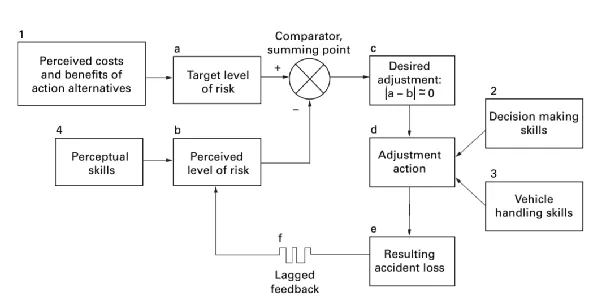
Homeostatic mechanism, after Gerald J. S. Wilde
I think it is important to set out three observations useful to our sport:
First, this means that anything outside the field of the “perceptible”, in the sense of direct (sensory) perception and of the meaning the participant gives it in action, does not affect the calculation and regulation of behaviour in the face of risk. Having a satellite positioning device in your harness pocket has no effect on the perception of risk in paragliding. No one feels or sees themselves as better equipped against risk with such a device. In plain terms, you do not feel, and you do not tell yourself, that you can escape an accident more easily with this box (unlike, for example, a reserve parachute or a more stable wing).
Second, as long as the perceived level of risk is indeed at its maximum (read: “I could die here”), all marginal adjustment measures (a helmet, a better back protector…) lead to marginal adjustments in participants’ behaviour. When you have clearly in mind the damage a cliff impact can cause, no one feels safer with a helmet, and no one feels their preferred risk seriously threatened by such passive safety equipment.
Above all, and if only one point were to be remembered, we must come to understand that the perception of risk in the moment is not the only factor that determines the participant’s adjustments. There is a cost/benefit balance that determines the very basis of the target risk, that is, the one preferred and used by the participant! This is box 1 of Wilde’s diagram. Four factors influence this initial definition of the target risk (1 and 4 being the most important according to the author):
And so, when the PE teacher announces four hours of detention for anyone who does a somersault, even with 60 cm thick mats, the target (newly “preferred”) risk of the pupils in a class drops dramatically. This is point 2 (“Costs of risky behaviour”); it is the speed camera policy on the roads, and in fact, theoretically, even in the light of risk homeostasis theory, it works! Note, however, that according to the author it would be preferable to act on points 1 and 4: reducing both the benefits of risky behaviour and the costs of safe behaviour.
In short, risk homeostasis theory does not say it is impossible to lower participants’ target or preferred risk through external constraints. It says exactly the opposite. It says that participants constantly adjust the risk they perceive to a subjective target risk, which is itself conditioned by a cost/benefit balance.
At present, in the light of this theory, free-flying pilots have problems at every level. On the one hand, perceived risk is cheerfully played down by all the beliefs of our community. We have seen that the idea of a safe activity with “controllable” risk has spread widely and that, in this sense, paragliding is often perceived as a classic outdoor activity, accessible to all.
On the other hand, even though our perceived risk is already low, we have bad signals in each of the four factors that would allow us to lower our target risk.
When perceived risk is low and, at the same time, preferred risk is high, behaviour tends to become more extreme. We must both reset our perception of risk (paragliding is not an activity like any other) AND create a new cost/benefit balance to change our tendency to aim for a high target risk.
Here I want to look at the first myths discussed in the light of a notion our community abhors: that of peril. Peril differs from risk in that it cannot be anticipated and is not inherently controllable. As Bastien Soulé writes61, “one takes a risk; one suffers a peril”.
We never talk about this concept, and we struggle to perceive the perils of paragliding, even though there are some. Perhaps the reader could pause and try to guess even one? What peril, during an ordinary flight, can cause a fatal accident while escaping any form of control or mastery by the pilot? Generally, we are so stuck in the paradigm of a sport with controllable risk that we no longer even see the real perils. From our pilot’s point of view, everything seems rationally controllable and avoidable.
Yet when thermalling in a gaggle, even without counting 90 wings, a minor error by a single pilot is enough to take a couple of colleagues nearby into a bad collision, or worse. And it happens more and more… Let us put ourselves for two seconds in the place of the pilot calmly circling while another one falls on them, wing in a mess. Where is the error this time? Perhaps the one falling could have done better, but the other one? It is a peril, like a heavy stone falling from the mountain at the wrong moment, in the wrong place. No one can anticipate or prevent the collapse of someone else’s paraglider, or a surprising and inappropriate line in a big gaggle. The only way to protect oneself would have been not to take up the activity, or to stay away from everyone.
Even supposing it were still possible to fly while being completely obsessive, pilots would not be spared peril. I have seen collisions with birds, and I have studied how pilots hit cables that are almost invisible from the sky. A fainting spell that would have been harmless on the ground sends a pilot straight into the sea. A dust devil, while preparing to launch with the wing barely laid out, lifts the pilot and then slams them back down. Even the physicists who study them can only measure them in the field when a vortex happens to pass over their sensors. In the laboratory, they arise spontaneously, simply from heating of the ground, without any trigger. Winds of up to 25 m/s appearing out of nowhere: that is the very definition of a peril62. A strong, sudden thermal release while flying along a ridge is not so fundamentally different. A big gust in the middle of an inflation or while picking up speed on the speed bar. The wind reversing strongly on landing while the pilot is behind the field, on base leg, as a big thermal or a breeze front goes through.
It is an illusion to think you can control all that. Sometimes you will pay the consequences of your commitment to this activity, even if it is not your fault. We are subject to perils. Just because they are less visible (air is invisible) does not mean they do not exist. Indeed, many pilots tell me about the ambiguous feelings they have towards free flight: an activity that is at once magnificent, indispensable and so frightening. Many federation members are not just a little scared in the air: they also develop forms of anxiety at the thought of going flying. You surely know some. When this happens, the main reason is generally that the body and the unconscious know full well that we fly not only managing (controllable) risks but also facing perils. Our “intelligence” convinces us that it is only a matter of managing the former, and it is precisely on this conflict that anxiety feeds. It can be cured over the medium term by working on acceptance: “OK, today I am going to do something that is not just a little risky. I need it, and I want to do it for this reason.”
Generally, after a few weeks, the anxious phases subside, because the basic premise is clearer and more honest. Yes, something can happen to you. No, it will not necessarily be your fault. Paradoxically, this idea allows a kind of relaxation and focus on the essentials. Not everything depends on you: if you manage the risks you perceive in the situation, that will already be good. At top level, in gaggles of 120 pilots at the start, we manage quite a few risks, but we accept many more perils. It is dense, it is turbulent, wings brush against each other a little. Obviously it is potentially fatal, but I cannot focus on it obsessively: I accept it. Yes, someone may fall on me. I manage my own margins, and I trust the others, the thermal and the wind so that everyone can do the same. In competitive group flying, you accept the peril or you leave the gaggle, with reduced performance.
Very experienced pilots are generally unable to perceive perils. Not only do they not see them, but they refuse to believe in them when shown concrete examples. Their reflex is always the same: they search everywhere for what the pilot could have done to protect themselves. A gaggle? “You don’t have to go in…” A dust devil? “It’s not that bad, you just have to choose your moment to launch…” A wind shift on landing? “You can anticipate that! You just have to turn…”
Peril has been erased from our vocabulary because it ticks none of the boxes of our community myths. If there is peril, the activity cannot be completely controllable (myth #1)… And accidents could also happen for external or even random causes, independent of pilots’ errors (myth #2). That would make the sky a place where one cannot fully adapt to overcome the difficulties found there (myth #4)…
All this is rather problematic, and peril is an embarrassment! So we hide it. Whereas we could bear in mind that a simple vasovagal faint, in our aerial context, sometimes ends in tragedy where it would have had no real consequence on the ground. If we decided to talk about it more, myth #1 of a safe activity would be harder to maintain.
In my role as a coach, I had decided to say that this kind of thing was part of the game. I told pilots to choose whether or not to accept the “risk” inherent in our game, that it was necessary for performance. In fact, I now realise that I was sometimes talking about perils… and that I can protect neither myself nor them from what we do. The overwhelming majority of our young athletes and their families accept this. They do as the grown-ups do. We train them and help them through the stages in order to overcome an apprehension that is instinctively entirely justified. A few exceptions do not get past this point. These young athletes then lose any chance of breaking through at top level, and we have to support them in leaving the programme and changing course. Taking risks and exposing oneself to perils in full awareness is not such a common choice, and it should be shared more explicitly with everyone involved. It is the kind of decision that must be taken in full awareness and without pretence.
I never used the word “peril”, but I had in mind a kind of distinction between risk activities on the one hand and extreme activities on the other. For a long time I believed that as soon as an activity involved an uncontrollable element, it was an extreme activity. I went as far as classifying paragliding as a risk activity and riding a motorcycle as an extreme activity. Because it was understood that motorcyclists are often exposed to the mistakes of car drivers. It was a classification I often referred to, convinced I had learned it somewhere (Risk sport -> Controllable / Extreme sport -> Danger suffered). I have discovered that no such classification exists in the literature, and how illusory control is.
You will still hear me say that paragliding is an extreme sport. I know (again thanks to Bastien Soulé) that the term has no academic rigour and is above all a marketing concept. The original “extreme” games (or X Games) were a franchise built around skateboarding, inline skating and BMX… Nevertheless, I want to help raise the perceived risk around our discipline, and the word “extreme” is now widely understood in that sense. An activity in which you can die. A sport where your life is at stake.
Where do these beliefs we have taken the time to dissect come from? How were they built? Why do they persist? There is a strong convergence of interests in promoting the central idea, number one in our earlier discussion, of safe paragliding with controllable risk.
That is, first, the direction of history. The pioneers really did have to learn to master their aircraft and their own activity. They knew little about their environment and about aerology. It is hard for us to remember where we came from fifty years ago, but the first hang gliders were delivered as kits to assemble yourself, sometimes with a single A4 sheet of instructions as the only explanation. Some pioneers even designed and built their own hang glider, paraglider or tandem. The only possible way to learn was by apprenticeship with someone who had already done a little, or by trial and error, often among friends. No wonder, in this context, that the desire for control is central to the collective imagination of free-flying pilots.
“It was risky back then; we knew nothing and we did any old thing.” “If there was really too much wind on one side of the mountain, we’d walk a bit down the other side to take off in the shelter.” “We’re survivors.”
These accounts invite comparison with the undeniable safety effort that has indeed been made over the past few decades. This effort was a necessity: it had to be shown that the activity perhaps involved a few risks… but that they were controllable! As a community, we made this effort to the point of convincing ourselves.
Indeed, the old-timers sensed long before us how society imposes a demand for sanitisation on people who practise risk activities. It is the free-flying pilots themselves who are called upon to demonstrate that their activity is safe, or risk having their new toys banned outright. The state also very quickly raises the question of how these activities are insured for the damage they cause. Who covers this risk? At what price? Who has an interest in doing so if the discipline is nothing but a form of open-air Russian roulette? Even today, third-party aviation liability insurance is a central issue and perhaps the only form of regulation of free flight broadly shared by most nations of the world.
Institutionalisation usually responds to this need for safety orthodoxy (a concept well known in physical education, which I borrow from Pierre Arnaud63). The aim is to gain a form of legitimacy, and the parachuting, gliding and free-flight federations logically seek to bring together, represent and defend the interests of their members. Making the activity safe is of major strategic interest for developing and democratising hang gliding and paragliding in the manner of a sports federation. An activity that appeared unsafe, all the more so in the air with an aircraft the participant could not fully control, does not fit the sporting doxa and risks being banned or marginalised. BASE jumping and wingsuit flying are a perfect illustration of this today, and are following the path taken by the first hang glider pilots and later by the band of friends having fun jumping off the mountain at Mieussy with pseudo-parachutes. Every community born around “extreme” (dangerous) ideas finds itself obliged to show its credentials and to organise itself to make its discipline credible in terms of safety.
In hang gliding as in paragliding, efforts around teaching and learning were immediate. Very early on, it became possible in practice to “learn” the activity through courses in schools. Wonderful teaching books appeared, and with them the first qualified instructors, who later structured the federation pathways. In France, pilot ratings appeared. A training pathway was born, covering everything from introduction to advanced level, with clearly identified instructors and specialists. All over the country, professionals are wonderful catalysts for the activity. They raise awareness, evangelise, and often even convert a wide public to free flight.
On the equipment side, the dynamic is similar. Although manufacturers have been praising the stability of their products since day one, the fact is that their products objectively improve and are increasingly subjected to tests carried out by independent laboratories. EN and LTF certification, and even the CCC standard in competition, are all attempts to rationalise and make more reliable the equipment available to pilots according to their level.
In reality, a great many developments in the history of free flight can be read through the prism of making the activity safer and keeping its participants safe. To the point that one can actually believe the pioneer era is over and that paragliding is now a safe activity in which pilots can control the risks. The myth of the reliable activity was born first to answer the main criticism levelled at the discipline. It is an attempt and a reaction. For the anthropologist and historian René Girard64: “If there is a normal order in societies, it must be the fruit of an earlier crisis; it must be the resolution of that crisis.” We have seen that myths are part of this normal order of things, and my main hypothesis is that we have come to believe firmly in a job that is in fact still in progress.
The good results of commercial aviation give a reassuring impression at the same time. As the journalist Malcolm Gladwell analyses65, accidents are considered exceptions. It really is possible to fly safely, and is the aeroplane not, after all, the safest means of transport in the world?
Our imagination does not include in-flight incidents and leaves no room for accidents once the traditional learning period is over… We can accept that a beginner crashes during their introduction if they are poorly supervised, but no one can see what could go wrong once that learning is over and the pilot has become seasoned. Thus, of all the superheroes with the power of flight (Superman, Wonder Woman, Peter Pan…), with flying devices (Iron Man, Harry Potter…), or even with the related power to defy gravity (Spider-Man, Batman…), none ever crashes once the initiation is over, even though many of them fall during this first learning phase. At a pinch, our imagination accepts a possible mechanical problem with the flying device as a cause of temporary failure, but no more. The reason is simple: since the superhero is perfect, they are not affected by human factor issues, and so they never have a flying accident. Those who fall are not superheroes, and everything comes together to make us believe that accidents are caused by human error (myth #2) and that there is no limit to flight (myth #4).
Despite decades of massive, concrete safety efforts, combining many intentions and actors, accidents remain. The community still does not count them very well, but everyone knows it.
The first, natural justification put forward by our world is the “hothead” effect. It is true that in the early years, alongside the teaching effort deployed everywhere to teach, democratise and give a more reliable image of our activities, many beginners continued to teach themselves, alone or with their band of friends. This practice has still not disappeared, and there is no doubt that the probability of an accident with this kind of self-teaching is much higher than with more professional and supervised approaches. Many problems were therefore reported, and logically the myth of accidents “caused by human error” was strengthened.
Nowadays, the word “hotheads” is increasingly replaced by “reckless”, but the argument remains the same. It is the one that helps turn the victim into a scapegoat.
Federation and commercial efforts to democratise these activities, together with the network of professionals developing across the country, with strong interests in training and in managing tourist flows, explain the link between the first two myths well. Barely caricaturing, the prevailing discourse then becomes: “Paragliding is great! Come and try it, anyone can learn, but to avoid accidents you have to get trained and/or be well supervised.” It was no doubt during the boom years (the 1990s) that this belief became most radical. Ten-year-old children were in the air, wings appeared in mass-market sports chains such as Decathlon, and big brands were considering investing in what might become a mass sport in the future.
The victims produced by our activities hold back a business that could be much bigger, and the collective and social pressure on those who have accidents does not diminish. Here I want to present yet another illustration of this victim/scapegoat ambivalence, which helps strengthen the power of our beliefs.
If we go back to Greek mythology, Daedalus does tell his son Icarus to fly neither too low, so as not to weigh down his wings with the dampness of the sea, nor too high, so as not to melt the wings of feathers and wax he made for him. As everyone knows, the story ends badly because the son does not listen to his father. The moral is therefore that accidents happen through inexperience, failure to follow instructions, or pride. It is the consequence of human error, and it is the victim’s fault.
Unfortunately, there is something even more pernicious. In our ecosystem, every actor has a direct interest in blaming the pilot who has had an accident:
Fellow pilots want to keep believing that their sport is safe and want to keep flying. The wing manufacturer guarantees that its machine complies and wants to keep selling more. The instructor systematically clears their teaching and wants to keep teaching. The federation counts, analyses, raises awareness (at best) and wants to keep receiving members.
It is important to understand that the victim/scapegoat logic, however symbolically rooted, also has roots in the search for liability after an accident. It is more convenient, from every point of view, for the system and its actors to think that victims made mistakes and are now bearing the consequences. It is also easy to rationalise in hindsight, and it is a tendency that, for once, is found in full in civil and commercial aviation. In fact, no one can ever say, even once: “something other than the pilot failed!”
Thinking that Icarus is at fault means we do not ask Daedalus why he did not use a few silk threads if he knew the wax would melt. Why did he have his young son fly for so long, and over the sea, on the very first try? We see a kid losing his head and dying of his pride, but we forget to ask what could have been put in place to avoid the tragedy. We pass over in silence what went wrong, and we do not talk about what we should conclude from it for future flights.
Myth #3, of a pilot who alone can ensure their own safety, comes from there. “Master on board, under God” is not so much a slogan to give the pilot full powers to carry out their mission. It is in fact what everyone wants. It implicitly makes the pilot responsible for any potential failure: if something goes wrong, it will be their fault. Most surprisingly, pilots themselves very often subscribe to this idea for its corollary, which implies that if everything goes well, it will be thanks to them.
There is a fairly simple, almost mechanical explanation for our habit of blaming the victim. It lies in the way we attribute causes to what happens to us. In Thinking in Bets, former professional poker player Annie Duke describes it very well66. When things go well for us, we see it as the fruit of our skill. When things go well for others, we readily see it as luck. Conversely, our own failures are down to bad luck, while those of others are explained by their mistakes.
This mechanism has long been known in social psychology. Fritz Heider showed as early as 1958 that we constantly seek to explain behaviour, attributing it either to the person (their character, their skill) or to the situation (circumstances, chance)67. Several systematic biases have been grafted onto this attribution theory:
Applied to free flight, these biases produce exactly what we have described in the previous pages. The pilot coming back from a difficult flight takes credit for having handled it well, when the air mass may simply have spared them. The pilot who has a scare talks of “rotten conditions”. But when someone else is injured or killed, we first look for what they did wrong: they were flying too close to the terrain, their wing was too demanding, they should not have taken off. That is what allows us to conclude: “it won’t happen to me”. Attribution is not just an individual reasoning error. It is the raw material of the scapegoat, and it feeds the myth of a pilot who is sole master of their safety.
This bias spares no one, not even our best pilots. Antoine Girard, distance world record holder, adventurer and a true hero of our community, says so with great frankness72:
“In paragliding, we are the ones taking the risks. There is no random side, there’s no gust of wind that suddenly arrives. Those things don’t exist; there are very few accidents where we’re not responsible. I’m not saying I won’t die paragliding, because accidents can happen, but if I die, there’s a 98%, even 99% chance it’s because I made a mistake. And so if I die, it will be my fault. Whereas in the mountains… I’ve had enough friends who disappeared. There’s no mistake, everyone is there, and one person in the group disappears, sadly. A stone in the wrong place, anything, you never know when it’s going to fall.”
In another interview the same year, he comes back to what drew him away from high-level mountaineering73:
“The notion of risk was very, very important to me, because in the mountaineering world, when you push it quite far, at a high level […], death is everywhere. […] I found it very, very unfair because it was Russian roulette, really: you’re walking, you don’t feel you’re taking any risk, nobody is taking any risk, and there’s a guy in front of you who disappears because he gets hit by a stone, an avalanche, something, while you, two minutes behind, are fine. And actually I don’t accept, or I really didn’t accept, that random risk-taking, whereas in paragliding… I’m not saying there are fewer accidents, all that… In paragliding, I think that everyone who has an accident, who gets killed or where there’s a problem, it’s 95, even 98% down to a human error at the start. We’re much less at the mercy of chance. If one day I die paragliding, it’ll be because I made a mistake, so I could have avoided it. I’ll have made a mistake, so that’s the consequence.”
This does not mean that Antoine Girard’s words lack humility. He acknowledges, after all, that an accident can happen to him. He stepped away from the Red Bull X-Alps because of the commitment such a race demands. He also set a 400 km triangle record in the Himalayas on a simple performance wing rather than a competition wing: he knows how to show humility and manage his risks. His words are those of an exceptional pilot, consistent with his flying and with the high standards he sets himself. That is precisely what makes them so revealing: at the summit of our discipline, the belief is at its peak. In the mountains, chance kills; in paragliding, it would always be the pilot. Accident reports tell a different story. In 2024 and 2025, in-flight collapses were the leading cause of reported paragliding deaths, and when they start close to the ground, the pilot often has time neither to recover the wing nor to throw the reserve (see “Knowing our accidents”). A gust that suddenly arrives does exist (see “Rejecting chance and uncertainty”, myth #4). Attributing 98% of deaths to pilot error is exactly what attribution theory describes: a way of keeping control over what, in part, escapes us. Just because it is less visible than in mountaineering does not mean it does not exist. “A guy in front of you who disappears […] while you, two minutes behind, are fine”: that is exactly what also happens in paragliding, at times.
Here I must deal with the submerged part of the iceberg and the reason why I think all the beliefs highlighted in the first part of this book do damage. In 1949, Joseph Campbell published a famous essay in comparative mythology: The Hero with a Thousand Faces. In it he posits the existence of a monomyth, a kind of structuring archetype for all the myths and folk tales of our societies. Every author and every era seems systematically to replay the same story, the same “hero’s journey”. Campbell describes the stages of this journey precisely.
 Infographic (in French) – The stages of the hero’s journey, courtesy
of Florent Salem
https://www.florentsalem.fr/concept-le-monomythe-de-campbell
Campbell’s analyses are much debated, but his journey has been taken up by many authors and by all of popular cinema. It is the spitting image of what a paraglider pilot experiences, on the scale of a career as on the scale of a single flight.
Leaving, being put to the test, coming back: that is what we live through every time we go flying. It is the hallmark of risk sports, because the outcome is uncertain. My hypothesis is not very pleasant to hear, but I think that by dint of seeing heroes, we wanted to become heroes74. I believe risk sports are the symbol contemporary society uses to fantasise about its heroes75.
After years of consuming heroic films and stories, we paraglider pilots wanted to live the same story. To become the heroes of our own reality76. Not necessarily out of narcissism. What we come looking for in the air is very varied: emancipation, knowledge, a culture of the air, contemplation, aesthetics, adrenaline, mastery, belonging, and yes, sometimes narcissism too. These motivations mix, and each of us nurtures our own, more or less consciously77.
I explained earlier how much the freedom of free flight is in fact that of transgression and of the relationship with limits. Being able to set oneself apart from most of one’s fellow humans, or from an earlier version of oneself. Coming back with this reward means completing a full journey cycle with a significant and uncertain trial. Either the traveller is indeed the chosen one, and will find along the way and within themselves the resources to pass the trial, or they are not, and so they will fail.
A potential trap appears as soon as this distinction is only made in comparison with a community of origin. Simply launching a paraglider is quite enough of a transgression for ordinary members of society, and yet it is no longer enough when the hero now belongs to a world where everyone already does it… The limit is pushed back, and with it comes the need for a new journey and a new transgression to regain the status sought within the community. The stars of our sport are those who have come through many journeys. The supreme event is the one in which the winner shows the whole world the extent of their power of transgression by shattering every limit imaginable: the X-Alps.
So it is as if, alongside the community’s prevailing discourse promoting sanitised, mass-market disciplines, pilots were in reality embarking on initiatory journeys and rituals far heavier with meaning. The justification and democratisation of our activities conceal what they fundamentally are: a wonderful creative space allowing citizens to find meaning again, to confront in nature and in practice the symbolism of the hero’s journey, ordeal included, and thereby to feel an infinite sense of freedom.
These rites and symbols may be widespread elsewhere in our society, but in risk sports they radically put physical integrity at stake. Paragliding victims recognise themselves as guilty of having failed a self-inflicted trial. The guilt here is that of the decision to leave and of the call to adventure (“I shouldn’t have gone”) or that of being unprepared: “I wasn’t in a fit state.” “I wasn’t ready.” “I was tired.” This transgressor’s syndrome signs and rationalises the hero’s failure. Those who have had an accident are left with two options: keep projecting themselves forward and set off on a journey again after a period of convalescence (the accident is then seen as one more trial, an obstacle on the path), or accept their humble condition and withdraw from the activity, forgetting the plan to go and seek their rewards.
I have something even harder to write. In this system, the death of our loved ones is unfortunately the proof that the ordeal was real (see “The freedom of free flight”). A trial from which everyone came back would not be a trial. It is our lost friends who give the journey its weight, and that is a terrible thing to say. They are, despite us, the hero’s ultimate justification. Some do not come back; I did. The mere fact of having come back underlines the power of what one has been through. Even when the only interpretation left to us is chance (“It’s a miracle I survived”), it gives oneself and the world the impression of being some kind of chosen one. The loved ones who are gone become, despite themselves, foils for those who remain. This is not a judgement; I am one of them. It is the story we tell ourselves that makes them play this role.
Once again, this mechanism is weaker in activities where death is perceived as a lottery. In mountaineering, as Antoine Girard said above, a stone falls on one person and spares the one walking two minutes behind: the survivor knows they were lucky. In paragliding, it is the opposite. Since we believe almost all accidents come from pilot error, the one who comes back owes nothing to chance. If they came back, it is because their skills did not fail. They are not lucky: they are all-powerful.
At the extreme, the community even has a word for these chosen ones: “SkyGods”78. The expression alone says everything about the ordeal-based hierarchy among pilots. The SkyGod is the one who has passed the most trials, whose supposed skills allow them to face ever wilder skies. We watch them launch while the others stay on the ground, and we tell ourselves that they know. Yet statistics remind us that the gods of the sky are very humble mortals. The typical profile of a pilot reporting an accident drawn up by the FFVL is not that of a beginner, but that of “a male pilot over 40 who flies fairly regularly, an experienced rated pilot who has an accident in the afternoon on a known site, rather at the end of the flight”79. And the mathematics of a pilot’s career (see “Who counts our dead?”) make no exception: the longer one flies, the more the risk accumulates. Yet SkyGods are precisely those who fly the most, the longest and in the strongest conditions. Very high-level pilots fall and die too; there are simply statistically fewer of them than ordinary pilots.
Those who come back tell of their journey, and those who do not come back tell nothing any more. This is where this mechanism meets the causal attribution discussed above. Statisticians call it survivorship bias: we draw lessons only from the cases that survived the selection and forget all the others. The pilot who came back naturally attributes their return to their skill, their judgement, their preparation. The share of luck disappears from their story, and with it the possibility of understanding what killed the others.
Crucially, let us note that what makes it possible to project oneself into this hero’s journey (as a paraglider pilot rather than in some other kind of adventure) comes precisely from our belief system. The combination of myths 1 and 2, of an activity conceived as safe but which must be tamed in order to survive it, allows a kind of “soft” ordeal in which modern pilots can engage with the feeling of taking a moderate risk that they will in fact be able to manage. That is how the community distances the activity from other forms of “Russian roulette” such as the mountaineering Antoine Girard talks about. Myth #3, of the pilot as sole master of their destiny, is the very echo of the hero: it is they and no one else who must take charge to pass the trial and, if they come back, take all the credit. Myth #4, in which no condition seems too strong for those who know how to overcome it, is part of the same imagination. Finally, the distortion of risk homeostasis theory serves to guarantee that if the hero has too much support, they will have to choose a harder quest to reach their goal.
The symbolism of the hero’s journey now reinforces the very beliefs that allowed it to take deep root in our imagination. It was not always so, however.
Our beliefs are built, evolve and strengthen over time and through the people who make up our community. It is interesting to see how successive generations of pilots and ideas about the activity shape each other. On the one hand, beliefs attract a particular type of participant, while at the same time these participants help to change the ideas slightly, allowing new, slightly different members to arrive, who in turn shape new beliefs. The direction of this development favours a broad democratisation of free flight as the belief in its reliability becomes established.
Contrary to what we intuitively think, early hang gliding and paragliding did not attract only daredevils and madmen. At first they in fact interested extremely polarised profiles. Very soon we find people focused on leisure, on gliding sensations and thrills, but further upstream and at the exact opposite, there were also people with proven technical skills, focused rather on understanding aerodynamic phenomena and mastering aircraft. Hippies, engineers. Inventors who were almost hippies and almost engineers too. Our activities would be nothing without the “Gyro Gearlooses” who took up the activity to build the necessary bridge between fun and open-air adrenaline on one side and the rigour and science that flight requires on the other. While these pioneers tried to make the aircraft a little more cooperative and efficient, the public drawn to this kind of activity was mainly of two types: either experienced, highly technical people from neighbouring disciplines or even from the military, who were aware of the risks and dangers inherent in these new disciplines; or people with very different professional skills but in full pursuit of thrills, as described by Marvin Zuckerman80.
As the first inventors worked to make the discipline safer and attitudes slowly changed under the impetus of early forms of institutionalisation, the public changed and grew with extremely skilled profiles. Often they were first instructors and practitioners of outdoor activities used to uncertainty and risk management. It was the time of mountain guides, ski instructors, climbers, pilots of other aircraft. At that time, you needed a certain pedigree to become a free-flying pilot, because the myth of a safe activity was still being built. It required either great skill or a good dose of ego, and some emblematic historical figures are famous for having mixed the two well.
This world stabilised during the 1990s, before paragliding caught on with teachers, primary school teachers and other knowledge professions. These were the first people of a more “general public” type, attracted by the possibility of mastering an aircraft in an aerial environment. Yet the activity was not yet designed for the “general public” as such, but teaching methods arrived and helped make the democratisation of paragliding thinkable as a new possibility.
There was great intellectual ferment; the network of professionals across the country organised itself and helped convert a larger part of the population, already won over and now convinced by the safety discourse and the apparent ease of paragliding. The system then took off, because seeing everyone do it reinforces the feeling of safety. This is when the activity opened up more widely to groups historically far removed from aerial disciplines: young people, women, people with disabilities. It was the era of PE teachers, school sport (UNSS), sports science degrees (STAPS) and university sports services (SUAPS). Only reality checks and serious accidents (of every profile) still partly held back the democratisation of our activities.
Today we find ourselves in this kind of reality check, with a paragliding that has taken many forms: speed riding, speed flying, ski-and-fly, parakiting, acro, freestyle, hike-and-fly, para-alpinism, soaring, competition or leisure, beginner vs. experienced, cross-country, accuracy landing, towing… Who wants what? The democratisation, then diversification and even individualisation (!) of outdoor physical activities have made them explode so much (Christian Pociello81) that it becomes hard to believe that all these people are engaging in activities where risk management is in fact not very reliable. Our beliefs are also strengthened by this democratisation, whereas in reality our collective safety systems have not kept pace and are struggling to take shape. That is the paradox we are living. How does this democratisation still work today?
The types of free-flying pilots have diversified in step with the belief in the reliability of the aircraft. Our activity is passed on first of all through ideological proximity. The “bug” the beginner catches on getting “hooked” on flying is in fact a new confidence in a world they had never considered until then. The more an individual is immersed in the belief system of safe paragliding, the more likely they are to take it up in turn. Families get their children flying because they believe in an activity that can be learned and in a reasonable risk that can be controlled. The children of instructors or well-known figures in our community almost all fly from a very young age. Most parents do not even ask themselves the question. To a lesser extent, spouses, brothers and sisters, cousins… also often get started through family. This mode of transmission is extremely effective, since it is direct and intimate. Values are shared within the family or the immediate circle. The conversion/transmission rate is almost total.
Barely further from the world of flying, mountain communities and people very close to outdoor activities are also easily won over by paragliding, because it is easy to compare this discipline, in terms of risk, with the others available in their environment. Do more people die skiing, climbing, trail running, mountain biking or paragliding? It hardly matters. People readily see these activities as places where death generally comes to take the careless… In fact, the logic kept alive by the free-flying community is already there, present and underlying elsewhere. The transfer is easy. This channel of transmission is effective, with very strong parallels and connections between sports: para-alpinism, combo, ski-and-fly, hike-and-fly… This spread is fast.
Professional and club schools and social media take care of converting the rest. Paragliding figures show an activity essentially centred on a tourist consumer product. In our world, it is often said that fewer than 5% of introductory course trainees or tandem passengers go on to fly. I have found no published data to confirm this, and once again it is a figure no one measures. But no professional claims the proportion is high. People come for sensations, memories, a moment of adrenaline, nice photos for social media, a daring timeless image, on holiday… This route to democratisation draws a massive flow, which explains why, despite the small conversion rate we have mentioned, many pilots are converted every year through professional, club and tourist activity.
All these dynamics of democratisation of free flight sustain a steady rise in the membership of the French federation: 34,387 in 2023, 34,744 in 2024, 36,189 in 2025 and 37,680 in 202682. That is nearly 10% more in three years, and more than 4% a year over the last two years. At this rate, and even counting only federation members, the number of pilots in France would double in less than twenty years. Growth is not the same in every country in the world. You will notice that wherever free-flying communities are smallest, confidence in our favourite aircraft is not really shared or effectively spread socially. In many places, paragliding remains a matter for daredevils, as it was at the end of the 1980s in France.
In Europe, and especially around the Alps, the democratisation and undeniable appeal of paragliding were born from the spread of our own community myths. We have massively succeeded in convincing people that paragliding is an activity with controllable risk. Every day we reduce the perception of the risk inherent in flying our aircraft, while at the same time the heroic symbolism and the imagination of flight remain intact. As a result, people from backgrounds ever further removed from nature sports, risk management and aviation want to join us and fly. I am not criticising this movement, since I come directly from it; I am describing it. Nothing destined me to fly; my parents (especially my dad) believed it was safe because that is what they were told.
Free-flight people dream as much as they defend the reliability and safety of their activities. A dream that is sadly unfinished, more than forty years after the first defensive reflexes needed to support an emerging activity faced with risks and accidents. The five myths we have described are the foundation of the stability of a community concerned about the risk-taking and accidents inherent in its activity. It is a complex belief system, shared by all free-flying pilots, serving at once the balance, the justification and even the evangelisation of paragliding as a discipline.
This belief system has one striking feature: it does not hesitate to divert concepts to justify itself. We have seen this several times. Wilde’s risk homeostasis theory, which describes how participants adjust their behaviour, has become an argument for refusing any external measure. Reason’s slice model, designed to stack technical, human and organisational protections, has kept only the individual’s slices in our world. Human factors, born to adapt the system to the human being, are used to explain what the victim should have seen in themselves. And the collapse, the main failure of our aircraft, has become a guarantee of safety. Each time, the tool is good. It is the way it is used that turns it around. It is probably not intentional: no one got together to twist Wilde or Reason. But it adds up, and all these diversions point in the same direction, the one that protects our beliefs. We take concepts made to change the system, and we use them to change nothing.
Before going further, we must do justice to what has been done. The current, pilot-centred approach has not failed: it has reached its limits. It has built one of the most advanced training systems in the world, with high-quality instructors, pilot ratings, SIV courses and reference books such as those by Pierre-Paul Ménégoz or Jean-Marc Galan. It has improved equipment, to the point that today’s wings have little in common with those of the pioneers (see “Deceptive sturdiness”). It has introduced certification tests, networks of weather stations, and a slogan, “One turn, throw the reserve”, which changed attitudes to the reserve parachute. It has even produced, almost without saying so, genuine systemic protections: “idiot-proof” hang glider wings, self-locking karabiners, devices against forgetting leg straps. And our figures prove it right on one essential point: where instructors are present, accidents are markedly less serious (see “Who counts our dead?”).
This book does not ask us to throw all that away. It asks us to add the missing slices. Individual responsibility remains indispensable; it is simply not enough.
We are reaching the end of a cycle. The growth in the number of pilots, the recent increase in accidents and their shift towards greater impact on supervised flying and experienced pilots no longer make it possible to maintain this status quo and the usual rhetoric of safe paragliding with controllable risk. When it comes to safety, the community is no longer making progress by blaming those who have accidents and by basing almost all its efforts on pilot training, awareness campaigns and the study of human factors.
Democratisation has made its way, and with it the diversification of the ways people fly. It is no longer possible to uphold the ideology of the responsible victim and the scapegoat, because some victims and/or their instructors no longer fit the profile at all, and there are more and more of them anyway. It is noticeable that some victims have broader shoulders than others. Somehow, a high-mountain guide, an instructor, an old pilot or a test pilot makes a much better victim than a young city woman arriving on an introductory course in our world of the air. It is easier to rationalise pilot error, getting stuck in habits, recklessness, poor decision-making, the lure of performance, pride… and conversely, it is harder to accept the death of someone culturally further removed from the activity. That is the direction we are heading in. Many observers see this as yet another consequence of our societies’ excessive focus on individual liability. And it is true that there is an undoubtedly appalling social trend towards wanting to sanitise everything, rationalise everything, insure everything and make everyone liable:
While this ideological battle is certainly commendable, that is not what this is about. The problem is that, as a community, we benefit from the spread of a belief system that remains effective for winning converts while producing many accidents. The tension does not lie in placing too much liability on pilots or their instructors. It lies in the ambiguity between what the community tries to do with paragliding and what it boasts about it to others. There is a form of deception, usually unintentional, in free flight today, because we structure the activity mainly around leisure and managing tourist flows, guaranteeing an aircraft that is simple, accessible and with controllable risk, when it is not and never has been. We give participants additional ways to take an active part in the society of the spectacle83 without saying a word about what they are actually about to do. The cult sketch by Belgian comedian François Damiens illustrates the whole absurd and powerful dimension of this situation: posing as a paragliding instructor, he wraps his passenger in a thick bundle of lines and asks him to untangle it all later in flight. Absolutely nothing that is asked seems abnormal to the layperson: not the partly torn wing, not the dazed instructor, not the “tweet / tweet-tweet” he is supposed to say… The (good-natured) passenger believes and does what is needed, because it is understood that the activity is safe and that nothing will happen to him. Indeed, that is exactly what he was sold: “With proper supervision, there’s no risk.”
Free flight is not condemned to stay this way. There are deep reasons why humans want to fly. I think it important to amend our beliefs with less pretence and by going back to the source of these aspirations. The freedom of flight hides a powerful symbolism that we have only touched on with the concepts of the hero’s journey and the ordeal. On this ground, risk, peril and death are omnipresent and are part of the quest (which ceases to be a game). There is no certainty, there is no guarantee, and obviously this activity does not sell as well, or at least sells very differently.
Our accident problem will find answers at the exact confluence of the strong democratisation we are witnessing and the completely outdated culture we keep alive. I see two possible directions for the future.
We can stay in the paradigm of “accidents caused by human error”, provided we accept remaining small and probably shrinking slightly. Contrary to a widespread idea, public authorities do not have much of a problem allowing highly risky activities to go ahead. Jumping off a cliff with a parachute, diving from a 30 m bridge… There is no shortage of Red Bull-style ideas, and in reality they are not fought that much. At least not as long as they stay on the margins and concern only a small number of individuals. Our institutions can go on maintaining that victims make mistakes and that the problem lies in pilot training and human factors, as long as the number of injured remains socially acceptable and their profile remains consistent.
“Staying small” means cutting off much of the democratisation of our activities, notably to the detriment of those culturally furthest from flying and risk. For a start, it is not very much in the spirit of Saint-Exupéry; we have talked about the emancipating role of our aircraft. What is more, it would restrict the socio-economic side of our community and the bulk of our activity, that of the professionals. Less consumption, less tourism, fewer newcomers and fewer conversions, refocusing on groups culturally closer to the outdoors, the mountains, risk and flying.
“Growing big”, on the other hand, can no longer go on being based on a series of myths or lies. We must learn to talk about our activities better, to design them and sell them differently. Our prevention, training and human factors policies are failures because we are not looking at the right things, continuing to focus only on the mistakes made by pilots while at the same time glorifying the mind-blowing performances of a handful of others. Our community is overwhelmed by accidents, and we must accept a shift in how we look at ourselves in order to take on collective responsibilities. Change our mindset, overturn our certainties and founding myths in order to better integrate new ways of working and new habits, and move towards something safer and more sustainable. If this last thought should remind you of another similar emergency (the climate), any resemblance would be purely coincidental.
Taking collective responsibility can easily go hand in hand with more regulation, more structure, more bans. It is an almost inevitable pitfall; however, we have seen the specific features of our activities and the complexity of their relationship with the notion of freedom. In free flight, if we want to win support for any measure or change in the direction of safety, we must try to spare the notions of freedom attached to the activity as much as possible.
This dilemma has been very well described by René Amalberti, a physician and specialist in the safety of high-risk systems. With Charles Vincent, he distinguishes three main safety models84. The ultra-adaptive model, that of activities that embrace risk, such as Himalayan mountaineering or deep-sea fishing: safety relies on the expertise, autonomy and adaptability of a few remarkable individuals. The high-reliability model, that of teams who manage risk without avoiding it, such as aircraft carriers or firefighters. And the ultra-safe model, that of commercial aviation or nuclear power, which avoids risk through standardisation, supervision and limits on individual autonomy. Amalberti also shows that an activity does not move from one model to another without changing its nature: becoming ultra-safe means accepting to give up part of one’s maximum performance and autonomy85.
That is exactly our problem. Free flight today is an ultra-adaptive activity that sells itself as if it were ultra-safe. I do not believe we should, or even could, become commercial aviation: that is not paragliding. But between Himalayan mountaineering and air transport, there is room for a free activity that equips itself with collective protections.
I have chosen to try to respect the symbolic dimension that flight holds for the pilot. The ultimate freedom, that of confronting death, must remain, at least symbolically. If we tried to stop our activities from offering an ordeal-like character to those who take part, they would immediately cease to exist as such. It would be something else; we would simply have killed paragliding or hang gliding. In this sense, I do not want to defend a sanitised, “regulationist”, “rigorist” line. We can see elsewhere what distorting outdoor disciplines for the sake of democratisation, commercialisation and safety can do. I hope indoor paragliding never exists, I prefer competitions in the mountains, and at the same time I want to put forward a few proposals and ideas for the future. Some are collective “tips” for the community or institutions; others aim to structure things by meeting pilots on their own ground, within their own symbolism, and simply trying to offer them a better hero’s journey!
We have described the beliefs that allow our community to live with its accidents without looking them in the face. This second part proposes ways out. They follow a simple logic. First, welcome accidents and their victims, because nothing will change until we say what is happening to us. Next, build a better system, that is, add the organisational and technical slices missing from our Reason model. Four chapters are devoted to this: knowing our accidents, informing better, equipping and training, then monitoring, alerting and rescuing. Finally, separate tourist flying from independent flying, to remove the ambiguity on which our safety discourse rests. A last chapter proposes setting ourselves numerical targets, to know whether all this works.
I promised to respect the freedom of free flight. The table below therefore ranks the proposals according to what they cost the pilot. Most take nothing away from them: they inform them, connect them to others, and help them rescue and be rescued.
| What the proposal asks | Proposals |
|---|---|
| Know more and inform better | Accident mapping, a TEM reading of our scenarios, accident forms that also record the system, more precise GPS tracks (IGC2), the WAT scale, reference level, weather stations, safety weather bulletins, a list of victims |
| Stand together | Just culture, listening to critical voices, lessons learned (RETEX), a victim support association, monitoring and assistance, volunteer rescue |
| Get organised | Site equipment and labels, safety equipment and training for each type of flying, a charter rather than obligations, professional use of VHF, transparency on equipment |
| Support and supervise | A long-term sponsor and mentor for every trainee, a dedicated framework for tourist flying and passenger flights |
None of these ideas is final. They are proposals to be discussed, improved and tried out.
Let us start with this. Accidents happen, and we must welcome them. With transparency and responsibility. This work is barely done at all, except through the narrow lens of accident reports and insurance. We would gain by caring for victims and their families more comprehensively and with new values. Of course, some tragedies are and will be hard to bear; some will again be particularly controversial and will directly involve various liabilities. So be it. That is the current state of what our community and our society produce. Let us accept it. Let us at least have the courage to say factually how our fellow pilots fall or have fallen. In all circumstances, even if we have to do so with conflicting points of view. Let us stop putting everything on the backs of the pilots who are gone and listing only their mistakes. Today, every actor behaves as if their own liability might be engaged, and the natural reflex is a code of silence. At best, federations note the circumstances, pass them on to the insurer and count them. In the most developed ones, perhaps someone even conducts an internal investigation. A few now publish a list of deaths or an annual analysis (see “Who counts our dead?”), but almost none publishes its investigations or speaks publicly about an accident. This is a curious defence mechanism, because it is an outdated strategy anyway… This is the age of social media and of the (sometimes hasty) search for liability and compensation. Silence from institutions or professionals is perceived at best as amateurism and at worst as an attempt to cover things up. Keeping quiet very often adds fuel to the fire. The courts have already heavily convicted large institutions, including the FFVL, as well as organisers and professionals, in France and in various countries. Today, cases are under way all over the world. Some may or may not lead to new convictions. There is no example where silence has improved things. When there is a proven problem or a presumed fault, insurers, beneficiaries, victims, prosecutors, the whole ecosystem tenses up, and there is no point in trying to get off lightly. Acknowledging wrongs and looking for deep, systemic causes without hiding behind the victim’s failings are the right attitudes; they move the whole community forward and are also more effective strategies in terms of defence and law. In many cases, the institution makes a better culprit and is more solvent than an instructor or a meet director. Yet any failings must be expressed transparently, and volunteers, professionals and other pilots must not be left alone facing liabilities that are in fact easily shared.
Just culture was born in aviation and high-risk industries. James Reason described it as early as 199786, and Sidney Dekker made it the subject of a reference book87. It rests on a simple idea: you cannot learn from mistakes if those who make them are afraid to talk about them.
A just culture is not a culture of impunity. It distinguishes the honest error, which every human makes and which must not be punished, from deliberately dangerous behaviour or gross negligence, which remain reprehensible. In between, it seeks to understand rather than to punish.
Civil aviation has drawn concrete schemes from it. In the United States, NASA’s ASRS has been collecting confidential incident reports voluntarily submitted by pilots since 197688. In Europe, Regulation (EU) No 376/2014 organises the collection of safety occurrences and protects those who report them. Airline pilots report their mistakes because they know they will not be punished for them89.
With us, it is the opposite. We have seen how the victim becomes a scapegoat (myth #2). Anyone who tells their incident exposes themselves to the judgement of their friends, to comments on social media and sometimes to legal or insurance consequences. It is therefore rational to keep quiet. To go back to the Bradley curve (myth #3), a just culture is the necessary step towards the interdependent stage: we cannot look out for each other if we do not dare tell each other what happened to us.
Promoting just culture in free flight would mean:
I am asking our community to tell its accidents. It would be dishonest not to start with mine. Few people suspect it, but my list is long. Here it is, warts and all.
Twelve episodes, including two spinal fractures. How many appear in a database? Two: the fractures, the only accidents requiring an insurance report. And for those that are recorded, what does the analysis form retain? “Piloting error”, “overconfidence”, “unsuitable equipment”. All true. But nothing that taught me anything is analysed or recorded.
This is just one example of a pilot’s path. I have not mentioned everything, because it is colourful enough already. You have the gist. Other pilots will obviously have less extraordinary stories. Yet I know very prominent figures in our world who hide theirs, and I respect that: most of the time, this kind of confession ends up being used against you. That is precisely the problem.
I am not telling all this to be pitied, nor to be judged. Some will judge me anyway, and that reflex is exactly the one this book describes. I am publishing my history because I am still here. Between the recognised coach and pilot I have become and the pilot who died young that I could have been, there is still luck. What we readily attribute to our skill owes a great deal to chance (see “Our own success, other people’s mistakes”). Not only is that where I come from, it is also what I have seen. Many pilots of the French team have been lucky and did not die in situations where they could have.
Let us publish our histories. Stars and ordinary pilots alike. Let us lance the boil and help the whole community shift its gaze. First, I have no reason to be ashamed of having crashed. Second, the community surely has a lot to learn from what happened to me. #ICRASHEDTOO
A just culture is not limited to welcoming those who have had an accident. It also means welcoming those who say what we do not want to hear. On this point, our community has a worrying reflex: it banishes non-consensual views. Rick Masters is the clearest example. His messages were received as provocations, the man rejected (see “Who counts our dead?”), and his old website is no longer online. Yet part of what he said was right, starting with that zone close to the ground where a collapse is unforgiving.
Annie Duke devotes a key passage of Thinking in Bets to this question91. To make better decisions, she explains, you need to surround yourself with a group whose common goal is to seek the truth rather than to reassure itself. Such a group thrives on disagreement. It values the minority opinion, because it is often the one that sees what the others do not want to see. It goes as far as organising dissent, with “devil’s advocates” or teams tasked with taking apart the group’s conclusions. The comfort of consensus, by contrast, is the ideal breeding ground for the biases we described in the first part.
Duke draws on the norms that sociologist Robert K. Merton attributed to the scientific community as early as 1942, summed up by the acronym CUDOS92:
Applied to free flight, these four norms have very concrete consequences. Communalism means opening up accident data. Universalism means accepting that a fair criticism remains fair, even when it comes from an American hang glider pilot we find unpleasant. Disinterestedness means recognising that manufacturers, schools and federations have interests, and that they cannot be the sole judges of the safety of our activities. Finally, organised scepticism means accepting that our most firmly established certainties, such as those this book calls myths, should be regularly put to the test.
Listening is not approving. One can reject Rick Masters’ conclusions about paragliding and keep his figures and his warnings. What a truth-seeking community cannot do is silence the person who disturbs it instead of checking what they say. In practical terms, our bodies could invite critical voices onto their safety committees, publish the counter-analyses they receive, and appoint, in every working group, someone whose role is to disagree.
A system only sees what it knows how to record. So let us look closely at our tools.
The FFVL accident report form offers two sections of contributing factors. The first concerns the pilot. It offers a closed list of fourteen boxes: poor observation, poor control, inattention, poor choice of take-off or landing, poor judgement of distances, poor assessment of the wind, impaired judgement, overconfidence, over-piloting, poor pre-flight check, inexperience, poor assessment of the weather, poor understanding of safety rules, and heavy traffic. Thirteen of these fourteen boxes describe a fault of the pilot. The second section concerns equipment and is limited to four boxes: the wing, the harness, the reserve parachute and the winch. That is all. There is no box for the site, the terrain, an unmarked obstacle, incomplete mapping, the organisation of a competition or a course, radio communication, rescue, or regulation.
The 2024 and 2025 reports show it. Out of 1,449 reports, 611 record at least one pilot-related factor, and only 47 an equipment-related factor93. The other factors have nowhere to be recorded, except in the free text, where no one will be able to count them.
The investigation report on serious or fatal accidents goes further, but it is still built on the same model. Its first part describes the pilot in detail: identity, occupation, age, weight, family situation, qualifications, years of flying, flying frequency, equipment, supervision. The site comes down to an address, a take-off and a landing. The second part leaves the pen free: sequence of events, direct causes, contributing factors, recommendations. This is a real opening, and the warning at the top of the report says so clearly: it “is in no way intended to determine faults or liabilities”94. But these free fields are neither coded nor counted. System-related factors appear only if the investigator thinks of looking for them. And there is no planned follow-up of recommendations: we do not know to whom they are sent, who must respond to them, or whether they have been applied. Finally, the report is for internal use only and its circulation is very limited. What it teaches stays in a drawer.
The FFVL is nevertheless one of the most advanced in the world in this area of collection and analysis. The aim is not to punish the best pupil in the class. It simply says a lot about the work of the rest. I sometimes write these reports. One concerned a fatal accident in a hike-and-fly competition: a collision with an unmarked goods-lift cable. The direct cause fits in one line. The contributing factors I was able to identify almost all relate to the system: a thin cable, with no intermediate pylon and no markings; a cable missing from most of the obstacle maps used by pilots and their routers; no unified European file of these obstacles; no sporting exclusion zone in a valley that is nonetheless full of cables; no common safety radio channel that would have allowed competitors who had passed earlier to warn the others. Fatigue, altitude and evening light come next. Yet none of these threats has a box in the report form. Once entered into the database, this accident will become a collision with an obstacle, perhaps with a “poor observation” box ticked. In other words, a pilot error.
What we need is a form that follows the logic of TEM (see “Myth #2”): alongside the pilot’s errors, boxes for threats from the environment, the site, the equipment, the organisation and information, and a box for the defences that failed or worked. With that, we could finally count what we today only recount. And every recommendation in an investigation report should have a recipient, an expected response and a public record of what was done about it. All this requires a lot of resources, but first of all it requires a change of mindset.
Every institution should therefore set up a reporting and lessons-learned system (RETEX, retour d’expérience). The community lacks a strictly public, free and open-access digital platform. Pilots, clubs, schools and professionals could report an accident and its circumstances, including when they are not directly involved (as witnesses). We must relieve our victims of guilt so that they agree to give an accurate account of what happened to them.
The FFVL has already tried. Around 2012, it opened a “BDNA” on its website, a database for reporting “non-accidents”. Four years later, it acknowledged that it “poorly meets the need for lessons learned” and replaced it with an incident report form. The same document admitted that “in the absence of reliable data on pilots’ flying hours”, data on ratings and accidents were “difficult to interpret”95. The intention was good. What was missing was what keeps a lessons-learned system alive: the trust of those who report, the publication of what is learned, and activity data to relate accidents to actual flying.
At international level, we could act by harmonising data. Offer a database to those who have none. Map accidents by severity, classify them by “similarity”, and try to tackle with TEM (Threat and Error Management) methods the two or three largest families of threats or “pilot errors” of the moment.
Tribute, empathy, warning. A list of pilots and passengers who have died in free flight would be welcome and would change the way we see our activity. BASE jumping has such a public list of names. It counted just over 500 people mourned in 2025. Who knows how many a paragliding or hang gliding list would count? We need to reset our perceived risk by looking at what we take part in from a new angle. We must take up Rick Masters’ work and make it reliable (see “Who counts our dead?”). There are already, without any doubt, several thousand free-flying pilots who have died. Let us own our impact on society and reflect a more realistic image of what free flight still is today.
We must help victims and their families more effectively and with more empathy. Each federation could set up a fund, with contributions in proportion to its membership, paid into an international non-profit organisation. This would make it possible to promote and provide emergency support to free-flight victims. Psychological, financial and legal support, search operations, organising rescue, repatriation, support for families, home adaptations, disability and death insurance advice. There is so much to do!
Before acting, we need to know what is happening to us: where, how, and according to which scenarios.
The statistics currently available to us (French and general, mainly for insurance purposes) show the following distribution of accidents: ⅓ on take-off, ⅓ in the air and the last third on landing. The 2024 and 2025 reports refine this picture: landing and approach account for more than 40% of accidents, take-off about a third, and flight one in five to one in four (see “Who counts our dead?”).
Through this mapping work, the take-offs and landing fields that cause the most accidents (there are some!) could be reported to the site managers concerned. I know landing fields with appalling statistics, some of them in sometimes “renowned” places. In some cases there is no other land available, and then the problem becomes thorny. Occasionally, on the contrary, there are alternatives, and we should make the effort to swap or redesign the usual field. Wherever the statistics are bad and the take-off or landing cannot be changed, we can flag a site as highly accident-prone with some form of signage.
There are slopes, gullies and ridges known for markedly disorganised convective activity even in standard flying conditions. In some areas, breezes naturally organise themselves to become stronger than our aircraft can normally handle. We also know more and more about convergences and breeze/wind shifts in certain places, with difficult consequences in the air and especially on approach. The fact is that accidents happen repeatedly in the same places. They often affect the same type of pilot, without us building on the knowledge acquired to prevent them effectively. We zealously map thermals and good flight lines, but we do not flag the areas we know full well to be dangerous.
We can also cross-reference accidents with particular weather or air-mass conditions in a given area. Wind strength in mountainous terrain is known to be a bad catalyst for accidents. Let us prove it and prevent it.
Mapping is not enough: we also need to understand how our accidents build up. The TEM method presented earlier (see “Myth #2”) offers a simple framework. For each scenario, we look for the threats (what comes from the environment or the equipment and is beyond the pilot’s control), the errors (what the pilot does or fails to do), the undesired states (the degraded situation preceding the accident) and the countermeasures (what makes it possible to detect and correct before it is too late). The point is not to name a culprit but to see where the system can act.
The figures that follow come from the 1,449 accident reports made to the FFVL in 2024 and 2025. They are partial, since not all accidents are reported, but they give an order of magnitude96.
Hang gliding accidents are rare in the reports (49 in two years for 350 members), but their distribution is clear: 32 relate to landing, including 13 base bar impacts, and 11 to take-off, including 8 falling back onto the slope.
Our instruments record almost all our flights. These tracks are often the only objective source available to an investigator after an accident. Yet the IGC format, which has become the free-flight standard, was designed for one position per second at best. That is the interval required at world championships, and even the “fast” mode triggered by the pilot (Pilot Event) settles for one point per second for 30 seconds. The specification does allow tenths of a second to be added, but only as an option97. And in practice, many devices record even less often: FLARM instruments, for example, are set by default to one point every two to four seconds98. Technically, our GPS units and variometers can do much better. But one second is far too long to understand an incident or accident in detail. A collapse, a surge, a collision or a fall often happens in less time than that.
I see this every time I analyse tracks for an investigation report. Different recordings often have to be cross-referenced, and even then, file resolution remains the main obstacle to reconstructing the last seconds of the flight.
Without going as far as fitting a mini black box, we could agree, pilots, instrument manufacturers and national or international federations alike, on a higher recording rate and on the common adoption of an “IGC2” format. It could also keep the accelerometer and heading data that some of our instruments already measure. A realistic solution for manufacturers would be to keep the latest flights in ultra-detailed form, at 5 Hz, then thin out older ones to 1 Hz. A kind of rolling black box, needing little memory. And it is precisely the latest flights that we need to analyse in detail. These files could feed directly into the accident database, with the agreement of the pilot or their family.
Many of our accidents begin with information that did not get passed on. Sharing what we observe, in the air and on the ground, costs the pilot’s freedom almost nothing.
Speaking of being able to communicate effectively about a real danger in the air, it is curious that after 40 years of existence we still have no common scale to talk about the conditions met in the sky. How do I warn my colleagues on the ground about what I am experiencing in the air right now? How do I describe the conditions here when they are still one glide behind me?
Sailors have the Beaufort scale, which lets them estimate the state of the sea according to the wind. Thirteen increasing degrees from 0 to 12, from flat calm to full hurricane. We find it harder to model the element of air as well, because in our case the effects of wind are not always associated with turbulence. That should never have stopped us from building a common observation grid for sharing and prevention. We must be able to talk about the aerology we encounter. Competition pilots have developed a three-level system:
Unfortunately, this system is not really applicable to wider use, recreational or professional, in which we look for more objective and descriptive (categorical) criteria. The three competition levels work (partly) among insiders sharing an implicit normative scale, monitored by an organisation that can decide to stop the task. For this reason, I propose a standardised descriptive system: WAT.
Wind / Ascent / Turbulence. W: the maximum wind speed encountered, in kilometres per hour. A: the maximum climb encountered, in metres per second, averaged over 20 seconds. T: the maximum level of turbulence encountered, on a scale of 0 to 3.
| Level | Label | Description |
|---|---|---|
| 0 | Stable – Laminar | No piloting needed in any circumstance. Stable pendulum. |
| 1 | Convective – Standard | Pitch control rarely needed. Some damping / braking. Moderate control inputs. |
| 2 | Turbulent | Active piloting. Thermal entries and exits must be piloted, disturbed airflow. Deep control inputs. |
| 3 | Severe | In-flight incident likely despite active piloting. Choppy air mass, including outside climbs. Reflex reactions to incipient incidents. |
The turbulence level (T) of the WAT
This reference scale for the air is not perfect, and I urge the community to build a better one. It mixes objective observations with feelings and, obviously, a degree of personal skill. What is severe for one pilot may be merely turbulent for another. However, in the absence of any other framework, if tomorrow I hear a pilot announce a WAT of W30, A5, T3, it will help me stay on the ground. I know very well what that means, and I no longer want that at the moment. In any case, it is a more precise indication than hearing “it’s a bit strong but it’s fine” or “there’s plus eight”, when the vario is still set to instantaneous. A famous anecdote on this subject: I remember a competition situation at Mévouillon, when I was a coach for the youth free-flight squad. The north wind is coming over the launch while we are launching facing south, and the meet director asks the poor souls going out low how the conditions are. One pilot answers: “It’s hammering to death.” Silence, then he goes on again: “TO DEATH!”, really insisting. And right after, he adds: “Level 2.” Just like that. It became an in-joke within the squad, because “Level 2” does not fit what came before at all. Announcing “Level 2” is supposed to indicate conditions becoming strong or dangerous, not a fight for survival.
Unlike WAT, which aims to be a semi-objective framework for reading air conditions, it can be useful to share subjective feelings, put in context and related to one’s personal experience. On a scale of 0 to 10, 0 being the calmest flight and 10 the most terrible flight one has ever personally made, where am I right now?
Comparing this level with someone of roughly the same experience helps one think about how one feels about the conditions, and regulate one’s level of arousal, one’s morale or that of a nearby pilot. It is an indispensable coaching tool that I encourage people to use to detect over-arousal and the moments when pilots become discouraged and more vulnerable. Hearing a young pilot with 3 years of experience announce a reference level of 5 when you are yourself above 7 after 25 years of experience is never good, either way. For the record, this tool was born after one of my worst training sessions as a coach. I misjudged an aerological situation that deteriorated near Font-Romeu. After a good hour of fierce struggle to keep the youth squad in sight and try to show them a reasonably safe way out, I land with one of them in strong wind but away from trouble. He says to me:
“That was a bit strong though, wasn’t it?”
To this day, that session is still my level 10. A horror. Where was he on his own scale? I would say 10 as well without hesitation, but supervision, youth and the rest meant he did not experience it that way. In such a case, it is important to go back over it and not to minimise, trivialise or derealise what happened, because there is a limit. And that day, it was close.
We should also step up efforts on networks of weather stations. Overall, this is handled relatively well in France and around the Alps. The SPOTAIR and BURNAIR projects are remarkable examples in this respect. They are of paramount importance for safety, and we must cover flying areas generously with a fine mesh of stations. The aim is both to analyse aerological data after the fact and to warn of conditions in real time.
At sea, when the Météo-France forecast exceeds force 6 on the Beaufort scale, a safety weather bulletin (BMS) is posted in every harbour master’s office, signalled on every lighthouse and broadcast on VHF channel 16. It is hard to miss information about bad sailing conditions. The overwhelming majority of recreational sailors stay in port or at a sheltered anchorage. Those who put to sea are mainly professionals, accomplished sailors or well-informed sportspeople. We very often know about WAT conditions incompatible with free flight, but we do not talk about them much. Let us post bulletins in our schools and broadcast messages automatically by radio. Let us inform those we see heading up to launch when the radar already shows the thunderstorm and rain in the next valley. Every action in favour of sharing information fosters responsibility. We could start by relaying Météo-France’s orange and thunderstorm warnings.
Next come the sites, the equipment, and what the pilot carries and learns, depending on the type of flying they have chosen.
Equipping flying sites is a serious matter, including for safety. Of course, thousands of sites are completely wild. With no agreement in place, using them offers nothing but a wonderful natural space to lay out a wing and take off. But for sites with an agreement, that is, those where there is some form of arrangement with the landowners, where traffic is heavier and, all the more so, those used by professionals, we can optimise our organisation and mutual support.
Examples of questions to ask, depending on traffic, might be: what space is set aside for pre-flight checks? Is there a hang point available to adjust new equipment? What are the practical options for getting back down if you decide not to fly? Are the take-off and landing procedures clearly signposted? Are nearby airspaces identified? On coastal sites or above a lake, the risk of a water landing should be explicitly mentioned and assessed: wind direction relative to the shore, distance to the water, whether or not there is any watch, the possibility of being picked up quickly. In 2024 and 2025, 11 water landings were reported to the FFVL, 3 of them fatal, spread across 7 départements, 5 of them in Haute-Savoie99. Having some form of site labelling (e.g. “Free-flight stadium” / “Major free-flight site”) and a standard to meet according to actual traffic or in proportion to the number of professionals would provide good benchmarks.
Absurd as it may seem, the colour of the wing affects how visible a potential accident is and how effective any search operation can be. Blue (sky), white (snow), green (forest), beige (earth) and black (rock) are colours that easily blend into the environment. Bright colours, shades of red and yellow, work better in most terrain. Before blithely dismissing this systemic argument (“well, just buy a red wing then”), it is worth noting that even in areas particularly well served by helicopter rescue, such as the Pyrenees or the Hautes-Alpes, paraglider pilots are sometimes searched for for weeks.
This section will not, however, stop at cosmetics; it intends to go into the detail of our fabulous aircraft, from design to production and testing. The community likes to remind anyone who will listen that equipment-related accidents no longer exist. This assertion is plain wrong, and in more ways than one. Even considering an equipment accident strictly as a structural defect, a part that “breaks” during the flight, some recent accidents still fall squarely into this category. A maillon, a tandem spreader bar, a reserve bridle, lines, attachment tabs… Of course some of us are still sometimes affected by breakage! It is terribly bad luck, of course. Wear, improper use, but also production problems can lead to errors and ultimately to equipment failures in flight. It is quite marginal, but when it happens, it counts. Manufacturers regularly issue recalls, to the point of pushing a few famous companies close to bankruptcy.
It is as if we forgot that quality control is carried out by the manufacturer itself. There is no individual checking intermediary between the manufacturer/producer and the consumer/pilot. Someone at the factory usually declares your wing compliant and fit for sale. These industrial processes are internal. Generally they are perfect, but I have received a new machine with a line 7 cm too long and another with brake lines far too short.
The very structure of your wing is probably laser-cut but is still sewn by hand. In competition, we know it is hard to have two identical wings. The smallest details affect speed and behaviour. And here I am talking about manufacturers who do the work, who design, test and certify. Nothing obliges them to. In most countries of the world, that is, outside the German-speaking market (which is more regulated), nothing obliges a manufacturer to do anything. It can outsource design, production and testing, and can even decide not to have its equipment certified at all.
Not so long ago, I saw a video on Instagram of a poor pilot who takes off perfectly from a grassy summit, glides 100 m above a ski slope and gets a total frontal collapse at 50 m above the ground with no perceptible warning. She crashes without much injury but badly shaken. Of course, the comments online lynch her at length.
Personally, I cannot quite see what she did wrong. In fact, it turns out the wing was a small, uncertified size from an otherwise reputable brand, which she will probably never fly again. Stories like this are legion. The extreme sizes (XXS and XXL) of wing models (even popular ones) are produced by scaling. The M size, or the one the research and development team can fly, gets all the effort, while the other sizes are generally derived from the main one. Obviously, the further you move away from the sizes specially developed by the designer and their test pilots, the worse the result. Not only are the smallest (or largest) sizes, for which the market is not big enough, not tested, they are not certified either. And the same goes for all products that struggle to fit the current definition of the standard.
Where they exist, certification tests have significant limitations. The current EN standard for wings and harnesses is defined by a working group of experts called Working Group 6 – WG6.
Its full name is CEN/TC 136/WG 6: it is the “paragliding equipment” group of the technical committee devoted to sports within the European Committee for Standardization (CEN)100. It brings together representatives of manufacturers, testing laboratories and national federations. AFNOR coordinates its work and the EHPU funds the administrative side. It drafts the standards EN 926-1 (wing strength), EN 926-2 (flight behaviour), EN 1651 (harnesses) and EN 12491 (reserve parachutes)101. These standards are voluntary: a manufacturer can choose not to submit its equipment to them.
I should point out that I have recently joined it myself, for the FFVL. The guide I mention below was written before I arrived. What follows is based on EN 926-2:2013. The text has been amended many times since, but the test conditions described here remain essentially the same.
These tests have limitations that must be known. They are carried out on a new wing, in calm air, by a test pilot sitting in a harness of prescribed dimensions. The standard spells it out: wind below 10 km/h and “no turbulence in the test area likely to disturb the flight tests”102. The test pilot induces incidents in a standardised way. A collapse triggered by hand above a lake is nothing like a collapse caused by an end-of-day thermal right next to a ridge. The classification therefore describes how a wing behaves during codified manoeuvres, not how it behaves in real turbulence. Nor does it say anything about how the wing changes over time: fabric porosity, line stretch, trim drift.
It is not me saying so; it is WG6 itself. In a guide intended for pilots, it presents EN classification as “a guide, but not a guarantee”. It writes that “it is not possible to reliably and reproducibly recreate real-world turbulence”, that the standard “does not measure passive safety in real-world scenarios such as thermals, wind shear or low-level turbulence”, and that the manoeuvres tested “represent only a small sample of the incidents that can occur in flight”. It adds that, even in calm air, a wing may react more severely than in the tests. We also learn that the tests are done in a seated harness, whereas many of us now fly in a pod103.
Then the same text concludes: “Accidents are rarely due to shortcomings in testing; they are mainly due to human error, poor decisions or lack of preparation by pilots.” What is this claim based on? No data are cited. And for good reason: we have seen that our report forms can hardly record an equipment factor, and that none asks whether the situation went beyond what the standard tests (see “What our forms cannot record”). The document that has just explained that the standard says nothing about how a wing behaves in real turbulence then claims that this gap causes almost no accidents. Myth number two is there, intact, from the pen of those who write the standard: when it breaks, it’s the pilot.
None of this takes anything away from the value of the tests. They remain an essential slice of the Reason model. But a slice has holes, and we should show them rather than let people believe that a certified wing is “forgiving” in all circumstances. A few ideas:
In forty years, the transformation of our equipment has been spectacular. But looked at closely, it has almost entirely concerned three areas: performance, comfort and lightness. Each of them has been heavily invested in by manufacturers and widely endorsed by pilots, who confirm these directions every time they buy, or do not buy, a product. Safety, for its part, has almost never been an area in its own right. Everyone uses it as an argument, but it has never sold anything.
A few examples are enough to show it.
Manufacturers have only followed and reinforced a market trend. It is consumers, magazines and influencers who decide what sells. A gain in glide can be measured, compared and demonstrated in flight, in competition or on social media. A gain in safety cannot be seen, except on the day it is needed, and on that day no one talks about it.
We lack information that no one produces. We have never kept statistics on which brands and models are actually the safest, in proportion to the number of units sold. Manufacturers know their sales, federations receive accident reports, but no one cross-references the two. Yet that would be the least we could do. It is also the only way to make safety a verifiable selling point, rather than a promise everyone makes.
Equipment does not stop at the wing and harness. Once in the air, the pilot is alone, and what they have brought along often decides the outcome of an incident. Most of these items may never be used. But on the day you need them, it is too late to go and get them.
Yet we talk about “the pilot’s equipment” as if there were only one. Because we do not separate types of flying, we cannot agree on what is necessary in general. Electronic conspicuity and trackers are the perfect example: useless for local flying by the sea, indispensable for cross-country in the Pyrenees. As long as we look for a single rule, we find none. Safety equipment is directly linked to the type of flying: you do not equip yourself the same way for evening flights on your home site, for a big mountain cross-country or for a para-alpinism traverse. A safety system worthy of the name should say so clearly, type by type, and teach it from the very start of training.
Once again, the world of sailing seems to have had a good idea in distinguishing the required safety equipment according to the type of navigation and the distance from shelter. That is exactly what we could take inspiration from. To stay safe on the high seas, you need more equipment than within 6 nautical miles of the coast.
I propose an equipment list that is not entirely far-fetched but remains hypothetical. This work deserves a broad debate within the federation and the creation of a shared consensus, first on the definition of the spheres of activity and then on the essential equipment. Adopting this kind of collective agreement will not be the work of one man. We will need to come together to agree on what makes sense, and that is what we cannot do as long as we do not separate the needs of different types of flying.
The baseline: site flying. As long as the pilot stays within glide of a landing field, they carry:
Coastal soaring. Over water, the danger changes in nature. To the baseline are added:
Cross-country. As soon as the pilot leaves the safety of the site’s landing field, they may land anywhere: in a tree, in an isolated gully, far from any rescue. To the baseline are added:
Para-alpinism. Here the logic is reversed. The para-alpinist carries everything on their back, on foot as in flight, and every gram counts: they want to fly light because they move through mountainous terrain where they must stay agile. Their equipment is therefore reduced to the bare minimum:
Acro. To the baseline are added:
In general, as long as we are circling close to the ground above our site, we mostly share the sky among ourselves. As soon as we go cross-country, we enter a space that others also use: gliders, microlights, light aircraft, rescue or military helicopters flying low. Their speed has nothing in common with ours. A glider spiralling at 120 km/h, a helicopter flying up a valley: at these speeds, the “see and avoid” principle on which our visual flight rules are based leaves only a few seconds. And a wing seen head-on, against a mountain background, is one of the hardest things to spot in the sky.
Others understood this before us. Gliding has equipped itself massively with FLARM, a system that broadcasts the aircraft’s position and alerts the pilot when a trajectory threatens to cross their own. Free flight now has several solutions: some instruments include a FLARM transmitter, others the open FANET protocol, and phone apps relay the pilot’s position to other users. Networks of ground receivers, such as the Open Glider Network, make these positions visible in real time, which also helps to find a pilot after an accident.
The problem is that these systems do not always talk to each other. A FANET-only device is not compatible with FLARM; only some instruments known as “FANET+” combine the two, to varying degrees. FLARM and ADS-B, the surveillance standard of commercial aviation and much of general aviation, are two separate ecosystems. A new lightweight standard, ADS-L, designed for low-cost, low-power devices, is being promoted in light aviation and free flight, with a dedicated plan in Switzerland (FASST-CH), but it does not replace the others104. Being equipped only protects you if the other aircraft is too, and speaks the same language. There are also limits specific to our activity: in a gaggle of twenty wings in a thermal, an alert system designed for gliders would sound non-stop. What matters for us is above all to be seen.
So this is a collective project more than an individual one. Federations, instrument manufacturers and other airspace users need to agree on a common standard, or at least on bridges between existing standards. We must also clearly recommend, from the pilot rating onwards, that a pilot going cross-country carries an electronic conspicuity device, just like their tracker.
The same logic applies to training. We train “the pilot” as if there were only one type of flying, whereas the essential knowledge changes with the environment. The pilot going cross-country independently crosses airspaces, meets other aircraft and may need to call for help far from everything. For them, a real knowledge of airspace seems indispensable, as does the use of the radio. For the pilot soaring by the sea or flying locally, within glide of a landing field, this is much less the case, or not at all. On the other hand, by the sea, you need to know how to prepare a water landing and be able to get out of your equipment quickly once in the water.
Rather than imposing a single package on everyone, often too heavy for some and inadequate for others, we could build training like equipment: a common core, then modules specific to each type of flying, which the pilot completes when they need them. In this core, first-aid training for all does not seem superfluous given the statistics: more than 700 accidents reported every year, one in three of them serious or fatal, and one pilot in five seriously injured or killed over twenty years of flying (see “Who counts our dead?”). On a launch, on a landing field or at the foot of a tree, the first rescuer is almost always another pilot. Knowing how to raise the alarm is crucial: you need to know whom to call, obtain and give a precise position, describe the injured person’s condition and the terrain, and stay reachable.
The training pathway could therefore be reviewed according to the type of flying targeted and the level of autonomy sought. At sea, the coastal licence is not the same training as the offshore licence. Operating a rescue device, securing yourself in a tree, getting out of the water: these skills are not equally useful everywhere. Today, the sequence of initial rating, pilot rating and advanced pilot rating is probably too general. I can be advanced in coastal soaring without being so in mountain flying, and vice versa. The idea is not to multiply ratings: the existing levels and colours can be kept. But training can evolve towards more modularity and individualisation.
In free flight, neither the equipment list by type of flying nor the tailored training are meant to become obligations. The idea is not to constrain, but to write them into a federation charter. A charter is a collective agreement: that of members who share a vision of what the activity should be and of how to access it. Everyone remains free to ignore it, but its use provides the framework and the common sense of direction. The pilot who goes cross-country without a tracker or knowledge of the regulations commits no offence as long as they do not actually enter controlled airspace. They simply know that they are departing from what the community considers reasonable practice, and that if things went really badly wrong, it would then be harder for them to plead ignorance.
Breaking the charter carries no penalty. Should we therefore believe it has no effect? That is not what I see in the field. Once safety practices are accepted, the community is on the contrary quite fierce in defending them itself. Post a nice video of yourself flying without a helmet on Instagram, and you will see! As a reminder, no regulation requires the independent pilot to wear a helmet. It is only required in schools, for tandem passengers, in competition, and where a prefectoral order requires it105. And yet almost no one flies without one. Peer pressure does what regulation does not fully do.
I lived through this transition phase with satellite trackers. At the end of 2021 and the start of 2022, after COVID, the FFVL national team had a large budget, since we had hardly been able to travel. I had 75 SPOT (Globalstar) trackers bought to equip every pilot in our sports performance programme. The federation paid for the devices and the first year’s subscriptions, and we handed them out, convinced we had done something great. The truth is that it took years for our athletes to use them. Very few saw the point. Pilots do not crash that often, and many thought that on the day it happened, it would be really unlucky not to have phone signal, all the more so in Europe or in the Alps. Today, many no longer go out without one, even outside official training. It takes time, but once the habit is formed, there is no going back.
A charter relies on that strength: it does not punish; it gives the community a benchmark and a common sense of direction to defend.
A charter has another advantage over regulation: it can evolve quickly. It follows the activity, the people taking part and the knowledge we accumulate about our disciplines, without waiting for a reform. It is probably the form most faithful to the spirit of free flight: a shared commitment rather than an imposed rule, which preserves the pilot’s freedom while telling them clearly what we know.
When an accident happens anyway, everything is decided in the minutes that follow: knowing it has happened, raising the alarm, coming to the rescue.
Today, the network of weather stations is not optimally integrated either into VHF use or into our flight instruments. This source must be available in real time and accessible effortlessly in the air. Some areas would also benefit greatly from a system of VHF radio repeaters. In many situations, they make it possible to overcome the usual range problems caused by our low transmission power and over-short antennas in mountainous terrain. And speaking of VHF…
Radio does not have a very good image in free flight. It is seen as a rudimentary, old-fashioned tool, and many would like to replace it with something more modern, such as Zello or even the mobile phone network. The trend in some schools is to simplify, with basic monitoring walkie-talkies. VHF is clearly underused and underestimated. Most free-flying pilots know very little about the tool: change frequencies, roughly set the squelch and channel step, lock the keys, and that’s it!
This is a real shame, because a tool like DSC (Digital Selective Calling) would be more than useful for our activities. If you have ever imagined being able to send an automatic alert message from your radio on a specific dedicated channel straight to the rescue services, know that sailors did it before us. It warns the listening authorities and all nearby users of the same system. You can select the reason for the emergency call directly from the radio, and it will share your location to direct rescuers to your position.
In our case, the free-flying community’s work on this subject is still not enough to secure, once and for all, a specific frequency band for our aerial uses. Even at national level, our only frequency, 143.9875 MHz, rests on a fragile decree from 1993. And yet France is almost an exception. In many countries, free-flying pilots simply have no legal VHF. In the United Kingdom, paraglider pilots’ use of the two-metre band has never really been legal: the authorities have only agreed not to prosecute pilots. In Spain, you need a licence that most pilots do not have. Elsewhere, many fall back on PMR446 walkie-talkies, limited to half a watt106. In Switzerland, communicating legally by radio requires an aeronautical radiotelephony licence, obtained through powered-aircraft, glider or balloon training, and a radio registered in one’s name107. In Germany, free-flying pilots have channels in the aviation band, but with a radiotelephony authorisation and an approved radio108. More than forty years after the first flights, our institutions have not known how, been able or been willing to get their states to recognise the most basic safety tool of our activity: being able to talk to each other in flight. While sailors and yachtsmen are in direct contact with the regional rescue coordination centres (CROSS in France) via a standardised, simplified international channel (16) and a dedicated phone number (196 in France), and while aviators call Mayday and Pan-Pan on 121.500 (the international distress frequency), paraglider pilots get by in other ways, and often alone.
We would gain by extending and professionalising the use of VHF. It is a fabulous, proven tool that has served air and maritime communications all over the world since the last century. Perhaps one fine day Starlink will make all this technology completely obsolete? In the meantime, having radios with the equivalent of an MMSI (Maritime Mobile Service Identity) and DSC establishing a direct emergency communication protocol with rescuers and other users, sending them coordinates, would not be superfluous. How much time is lost in communication? In collecting and sending coordinates? In misunderstandings about the location of a crash? How many accidents with no way of raising the alarm?
“Hang on, I’m landing. I’ll text you, share it with me on WhatsApp. Open the app. It’s my partner who got the message by email…” All this is ridiculous! When you think that all the rescue services (mountain rescue, firefighters, civil protection…) are also equipped with VHF and are just waiting to receive relayed information. This kind of development, and the lobbying that goes with it, is not beyond our community’s reach. In return, however, it may also mean training and taking a restricted radiotelephony certificate. Probably not so utopian to rely first on professionals and a few enthusiasts.
We hold a famous belief that VHF does not work well. “Because of the terrain.” But what I most often see in the field is a radio bought on sale at the lowest possible price, fitted with a dubious battery, a bent miniature antenna and a damaged antenna socket. If there is a remote set-up, it is most often a wired microphone whose connector clearly will not last long. That is the typical caricature, and it concerns the pilot who is equipped. Many pilots simply have no radio. Among instructors or organisers, who works at 25 watts with an extension cable and a good antenna? Which professional has equipped a landing field properly for the instructor guiding approaches (electricity, fixed radio, sunshade, water, comfortable seat…)? Apart from windsocks, the community more readily installs a bar or a barbecue than any other facility (radio relay, internet connection). It is a question of culture.
If you look at a student’s radio, the TOT (Time-Out Timer) is usually not set, the squelch barely so, and no one uses a tone or coded sub-channel to block interference from the main frequency, even though we know full well it is open to all comers. The details and tips of using this tool, indispensable to our activity, are missing from training content. Free-flying pilots do not like VHF because they do not know it and use it badly. Meanwhile, channel 16 and 121.500 save lives every day.
I no longer wear canvas trainers to go flying; I switched to trail shoes long ago. I did not start wearing them for my own safety. I did it to stay useful just in case. Several times I have found myself rescuing injured friends on steep or slippery ground, or in trees. I have also had some bad experiences, because without the right equipment (phone, shoes, radio, battery…) or the right training (first aid, physical fitness, knots…), you are potentially useless to your fellow pilots. From the start, I understood that this sport could take a friend from me now and then, and I accepted it. That does not mean I will accept living with regret or negligence. I want to keep that strength and do my best. I will not go out partying the night before a flying day. I will do it on an evening when there will be no flying the next day. I charge the radios, the batteries and myself… We know what our activity involves. “With great power comes great responsibility,” said W. Churchill (or Spider-Man, depending). Let us do what is needed, all the more so when we are coaches and/or professionals.
Helping a person in danger is a legal obligation in most countries of the world. In my work for the FFVL, I have sometimes had to investigate fatal accidents. It is incredible how, in most cases, pilots who went flying together do not realise that one of them has had an accident. What is the VHF listening protocol used in free flight? There is none. How do we locate each other? Most of the time, pilots do not. What would you do if one of your friends stopped answering on the radio and their position showed them on the ground in difficult terrain? If this question has an obvious answer (“I call the rescue services”), then we could easily give ourselves the means to have this information: tracking and radio contact.
The community is fascinated by distance records and the X-Alps. Yet many seem to forget that during these events, safety protocols are very precise and rely on a large collective effort. Athletes are generally in constant contact with their supporter(s) and are followed continuously on live tracking. Sometimes the supporter sitting behind a screen does it from home; sometimes from the athlete’s van during the race. Often there are several of them, remote and on site! Of course, tracking stays on all the time and emergency numbers are known. It may not be very “Mike Horn”, but it is very reasonable. Even in the Vendée Globe, competitors give themselves the means to keep watch and assist one another. I guarantee that these protocols take nothing away from the pleasure of flying all day over 460+ km. Quite the opposite: it is very pleasant and liberating to know that everyone’s safety will be taken care of if something goes wrong.
The duty to listen and assist at sea consists of committing to listen to the same radio frequency in order to be able to help if necessary. Of course, the context is different, notably in that:
Victims have more time on the water. Boats generally do not sink instantly. Almost all shipwrecked people can be saved, at least for a while. A paragliding accident unfolds on a different timescale, and there are many more cases where victims cannot raise the alarm themselves and where rescue operations will change nothing.
On the water, there is an urgent need to intervene immediately, because the ocean or the sea may swallow everything if rescuers arrive too late (lost with all hands). On land, this urgency is less pronounced.
Even so, how can one not be won over by the idea of a community committed to keeping its own watch and assisting itself in the face of the risk and peril of its shared passion? Sailors, but also mountaineers, sometimes try to go and fetch their unfortunate friends, stuck or in a bad way, at the risk of their own lives! I want to believe our community is made of the same stuff. I have investigated fatal accidents where a pilot crashes and stays alone on the ground for hours while their friends fly over them in a thermal ten minutes later. This is not an exception; I am talking about a recurring, repeatedly documented scenario. Most of the time, spotting from the air is difficult. Making out a wing without bright colours in the middle of the mountains is a delicate exercise, even for a helicopter pilot or an experienced rescuer. And believe it or not, in some cases even with roughly the right coordinates! If free-flying pilots do not stop to help their fallen friends, it is not out of selfishness or individualism. Sometimes they do not see them, and they assume that in the absence of visual proof of an incident, all is well. Afterwards, 100% of the friends are shocked and blame themselves for missing the right information. Almost every time, we reassure ourselves by saying it would not have changed anything, that the impact or the accident was too severe, that the victim died instantly. That is true most of the time, and yet across all cases it is not always accurate. It is a relief to think it, to say it, and it frees everyone from guilt. Nothing will bring back our fallen friends. In truth, what is wrong is that we are in the 21st century but we still fly without a defined radio protocol and without any automatic distress system.
Another borrowing from the world of sailing! While civilian and military staff coordinate the rescue system via the CROSS centres, operationally they mobilise a veritable army of volunteers from the French national sea rescue society (SNSM), which has more than 200 lifeboat stations in France. In the absence of such an organisation to watch over an entire coastline, I think we could still organise a few watch rotas ourselves in our major leisure flying areas.
At our latitudes, the paragliding season starts in spring and continues through summer before gently fading with the arrival of autumn and then winter. Nevertheless, the community loves to travel, and the season increasingly looks like a series of ritual gatherings at famous spots around the globe: September in Val di Fassa in Italy, October in Ölüdeniz in Turkey, November in Bir in India, December in Tenerife, January–February in Colombia in the Valle del Cauca or in Mexico at Valle de Bravo, and so on. Often the flying area hosts over 300 leisure pilots a day. Everyone flies and lives at the local rhythm. Probably no one has ever devoted a single day of their time to monitoring and coordinating rescue for friends who have gone flying. How could they? Absolutely nothing is planned for it. In the most exotic countries, where coordinating rescue and raising the alarm are still complex or unusual processes, we could organise temporary stations equipped with a radio and an emergency number, providing a direct link with the authorities. Having a couple of trained volunteers give one day of their stay would be rewarding. We would probably even be happy to fund this kind of initiative if we had to and if it were undertaken locally. We already pay for plane tickets, accommodation, site fees and lifts to launch, not to mention post-flight beers. We must realise that this kind of rescue system would serve to protect free-flying pilots. That is, ourselves. Carrying on as if everything will be fine when we know, year after year, week after week or day after day, that it is not the case, is irresponsible.
Along the same lines, would it be hard to imagine a couple of volunteers dedicated to watching live tracking on good days? With a PureTrack-type platform dedicated to detecting, checking and alerting? With other FFVL coaches, we spend a lot of time watching pilots’ performances and tracks across different areas. Several times now we have tried to find out how a pilot visibly in trouble on the tracking was doing. Finding their number, contacting them, checking, and if necessary raising the alarm and then contacting their family is never a small matter. The feeling of helplessness is sometimes terrible and turns an apparently harmless experience into a nightmare. Yet the community can decide to organise this monitoring very easily. It takes a little time, willingness and a few protocols, nothing more. I am lucky to have access to a federation intranet with phone numbers and emergency contacts for many pilots. It has already come in very handy several times. What will you do when you see me crash live during the French team’s next distance record attempt? Whom will you call? How will you raise the alarm hundreds or thousands of kilometres from my crash? These are questions we can and must answer quickly.
A controversial chapter, but an indispensable one. We need to get out of an ambiguity that runs through our whole activity: we sell the same thing to two groups who have nothing in common.
My proposal fits in one sentence: separate tourist “teaching” and tourist instructors from the real ongoing training of pilots in the activity. Those who really take it up need a long-term mentor, and a real one.
On one side, there is the independent pilot. They chose free flight, they trained, they gradually accepted the share of risk and peril that is the essence of the activity. They are the one living the ultimate freedom and the ordeal we have discussed. It is their hero’s journey.
On the other, there is the tandem passenger or the trainee on a first flight or an introductory course. The vast majority will not come back (see “The power of our beliefs”). They come for a sensation, a memory, a nice photo. FFVL members report about 130 tandem accidents every year, and half of all reported accidents happen in supervised flying (see “Who counts our dead?”). They did not choose the ordeal and often have no idea it exists. They were told: “With proper supervision, there’s no risk.”
These two groups fall under two opposing safety logics. The first can claim the right to take risks for themselves. The second has entrusted their life to a professional and rightly expects a level of safety close to that of passenger transport.
Today we do the opposite of what this distinction would require. We apply the discourse of autonomy to tourism (“paragliding is safe if you respect a framework”), and we let the independent pilot believe that this same discourse protects them. The first is under-informed, the second over-reassured. That is what I called earlier a form of deception: we guarantee an aircraft that is simple, accessible and with controllable risk, when it is not.
This mix has a direct consequence on pilot training. Our best instructors are now busy managing tourists. Tandem flying is obviously more lucrative, and school training is also designed to capture and manage flows of trainees who come and go with the seasons. The business model is one of discovery, not of progression.
Make no mistake: this is not a text against professionals. Our figures even say the opposite. Accidents in supervised flying are markedly less serious: about one in five leads to serious injury or death, against nearly one in two in unsupervised flying (see “Who counts our dead?”). Our most severe accidents happen exactly where instructors are no longer present: after leaving school, and in the types of flying considered independent.
Apart from a few very personal, school-based or strongly club-backed initiatives, permanent schools where a pilot can really train over the long term, with longitudinal follow-up of their training, are almost non-existent. When any instructor can deliver training around the same introductory or improvement courses, expert instructors become indistinguishable from beginners. For the student, nothing distinguishes the one with twenty years of cross-country and seasoned flying (competition or not) from the one who qualified two years ago.
The real training courses, those that help an already independent pilot progress, are underpaid relative to the responsibilities involved, and therefore under-invested by our experts, who often fly tandems instead. The most precious knowledge in our community, that of pilots who have seen the limits up close, is thus spent taking passengers for rides rather than being passed on. And even when it is passed on, it is not done optimally, for lack of a suitable framework. The types of flying described as independent are hard to teach as things stand (cross-country course, brown level, SIV, etc.), because instructors and pilots are asked to enter a fleeting teaching relationship: a week at most, repeated each year at best, whereas this is precisely when detailed knowledge of each pilot and teacher matters most. The instructor discovers a student they may never see again; the student leaves alone with what they have understood and handles their own follow-up. It is to address this gap that I propose, further on, the figure of the mentor: not to replace the instructor, but to provide the continuity that a one-week course cannot offer.
Separating tourism from pilot training requires real work on profiles and on the “why”. Why does this person come to fly? For a sensation, a memory, a holiday outing? To discover an activity they have always dreamed of? Or to really embark on a career as an independent pilot? These motivations are all legitimate, but they call for neither the same content, nor the same teaching, nor the same discourse (see “The hero’s journey” on the variety of what we come looking for in the air).
We must also dare to say it: not every type of flying is necessarily meant for everyone. This is not elitism. It is recognising that mountain cross-country, para-alpinism or acro require a commitment, a relationship with risk and an investment that not everyone wants, or is able, to make. Saying so early is respecting people.
I therefore propose clearly separating three things that are blurred today:
The teaching, the discourse and the rigour of these three moments are hard to reconcile. You do not talk in the same way to a holidaymaker who wants a nice, friendly week in the spirit of an outdoor holiday centre and to a future pilot who will one day have to decide alone whether to launch. Mixing the two means either frightening the first or wrongly reassuring the second.
Separating does not mean banning or condemning professionals, who keep our activity alive. It means recognising that commercial passenger flying is a different activity, which deserves a different framework:
If the trainee pilot should no longer be treated as a tourist, what should we offer them instead? For those who really take it up, a long-term mentor, and a real one. I believe we can make the hero’s journey our own. In Campbell’s story, the hero never really sets out alone: someone calls them to adventure, and someone else guides them as they cross the threshold. Our supervised flying could offer the same to every trainee.
A sponsor. The sponsor seems to me able to remain optional, but they are the person who takes on the heavy responsibility of the call: the one who brings the trainee into free flight and its community. I imagine a volunteer relationship, of protector and guide. A relationship that matters. The sponsor is a first source of support, someone with whom one can talk about one’s progress, one’s doubts and the customs the community passes on by word of mouth. Agreeing to sponsor someone means recognising that you do not lightly bring a friend into an activity where life is at stake.
A mentor. The mentor is the catalyst of skills. They are in charge of training the young padawans of an area. They coordinate the trainee’s pathway from start to finish. Today, training is often fragmented: a course at one school, another elsewhere, a wing bought on a friend’s advice, a progression no one sees as a whole. What is missing is Gandalf or Master Yoda. Someone who knows the hero well and follows their student scrupulously on their journey. Together, they discuss the quest, the reasons for the journey and the best ways to reach the goals: the courses to take, including at other schools, changes of wing, “consumer moments” and the stages of progression. All this must be built with a mentor because the traps are too many and too hard to handle alone.
This mentor is not the instructor or tandem pilot one may often come across. They are a grand master, an undisputed expert in the discipline, recognised as such by all. They have a great deal of flying experience, over a decade of flying in extremely demanding settings such as competition: cross-country, acro, racing. They have seen the limits up close, in others and in themselves. That is precisely what allows them to help a trainee choose their quest without picking the wrong trial.
For me, this relationship between the pilot and their mentor does not end. A pilot may well want to find another mentor along the way, but in the end it does not matter: what counts is that there is always someone. I have been flying at top level for more than a decade, I am a respected coach and a recognised pilot, and yet from time to time I have questions about my flying and need to talk to someone about it. I fly barely more than 100 hours a year, I fly an Enzo 3, always in competition, in varied conditions, trying to follow pilots who are three times my level. I do it above all for professional and social reasons. It is not the best cocktail. How long can it last? Personally, I am lucky to have solid contacts in this world, people who know me, know how to talk to me and look out for me. What happens when you do not have that expertise at hand? What happens when the quality of the advice you get is poor? When it is influenced by a dealer, an organiser, a good friend who is a little too enthusiastic?
Advice in our world is rarely neutral. The person selling the wing has an interest in you changing it, the person organising the event has an interest in you coming, and the friend who flies hard wants you to follow. No one is dishonest for all that, but no one is disinterested. That is precisely one of the norms Merton set for any community seeking the truth (see “Listening to uncomfortable voices”). The mentor must be its guarantee: someone who knows the pilot over time and has nothing to sell them.
We need to build such a system. Help competent professionals to reinvest in long-term training, in their immediate flying area, around goals set differently. Move away from tandem flying, while genuinely finding an economic interest in teaching within real free-flight schools, not in for-profit organisations but where the pilots are, that is, within clubs. Regular supervised flying, detached from seasonality and tourism, and mentoring work should be encouraged and heavily subsidised. Not only must we be able to support every cohort of first-year members, but more broadly almost all our pilots should be followed longitudinally by a professional expert in the discipline. I am not proposing to make this relationship artificial or to impose it, but we could start offering this kind of support to our new pilots and see where it takes us over time. Funding follows the same model as everywhere: the pilot keeps paying their teacher, the club pools resources, the federation subsidises what it can… In case it was not clear, this is about reorienting our leisure clubs towards “sport”. By sport I do not mean competition, but the model is indeed similar to the one a coach has with their athletes. So let us finally (!!) open schools offering regular year-round flying, rather than scattering the same money over crowds of itinerant and/or tourist courses. We can reverse this trend and make what is the rule today become the exception tomorrow, and vice versa. It is fascinating to see that free-flight clubs all organise “club trips” to a host of destinations but do not so often organise flying at home, or at least not on a recurring or professional basis. Even big clubs, with more than 500 members, employ no coach. Our best instructors remain self-employed and work seasonally. The day we manage to change this through the system, without worsening their working conditions, we will instantly gain in safety. It is not impossible, and it is in this kind of challenge that we expect federations and the major players of free flight to step up. In any case, that is all I wish for the world of tomorrow and for the job of future teachers.
Everyone talks about safety: federations, schools, manufacturers, organisers, clubs. But what do we concretely expect from it? Who gives themselves a real project, or even a quantified forward plan? I have seen announcements, campaigns, projects and concrete measures, but we very rarely write down in black and white the intended result, or the date on which we will check it.
Should we aim for zero deaths? This book has shown at length why and how the very nature of our activity seems to run counter to such an ambition. Should we then define a threshold of acceptability? Per pilot or per hour flown? That seems morally very difficult.
In any case, without a target, a safety policy can neither succeed nor fail. A good year becomes proof that the measures work; a bad year becomes a stroke of fate. All the proposals this book has put forward are only worth anything if, after a few years, we can say whether or not they have helped. I would like to propose at least two fundamental criteria for this.
The first is almost arithmetical. More pilots means more accidents. If the risk stays the same for each pilot, the number of accidents and deaths simply follows the number of pilots.
And that number is rising. The FFVL went from 34,387 memberships in 2023 to 37,680 in 2026, more than 4% a year over the last two years (see “The power of our beliefs”)109. Since 2007, the federation has lost on average about 5 paraglider pilots per 10,000 memberships each year: 4.4 between 2007 and 2016, 5.9 between 2017 and 2021, 5.0 between 2022 and 2025110. At this rate, 37,680 memberships give about 19 deaths a year. With twice as many members, which our current growth makes conceivable in less than twenty years, it would be nearly 40. Without anyone having flown any worse.
The first target is therefore to stop this mechanical increase: for the number of serious accidents and deaths to stop following the number of pilots. It is not an ambitious target. It is the minimum. But it is a first sign that safety measures and policies are paying off. With growth of 4% a year, keeping the same number of accidents already requires each pilot’s risk to fall by about 4% a year, that is, by a third in ten years111.
This criterion must be read over several years, and not only on deaths. We have seen (see “Who counts our dead?”) that with a few dozen deaths a year, a difference of three or four deaths proves nothing. The roughly 700 annual accident reports give a more solid measure. Between 2024 and 2025 they remained stable, 728 then 721, while the number of memberships rose by about 4%112. That is encouraging, but two years do not make a trend. And the trend in deaths over 2017–2025, a fall of about 5% a year, is not statistically significant113. So we do not yet know whether we have reached this first milestone. Setting the target is giving ourselves the means to find out.
The second criterion is more demanding. It concerns the repetition of accidents by type.
Seeing an accident happen again really is an admission of failure for safety projects. A first accident can come as a surprise. The second, in the same scenario, much less so: we knew. And our accidents do repeat themselves. Collapses close to the ground account for 10 of the 23 paragliding deaths reported in 2024 and 2025 (see “Knowing our accidents”). In 2026, eight more fatal accidents happened on cross-country flights after collapses close to the ground, with no reserve deployed (see “Who counts our dead?”). The same take-offs, the same landing fields, the same gullies come up in the reports year after year.
The target then consists of following each major family of accidents, those that a TEM reading makes it possible to describe, and setting a result to be achieved for each. Collapses close to the ground, water landings, failing to clip in, hang glider landings: for each scenario, how many accidents today, how many targeted in five years. And every time an accident happens again in an already known scenario, the question to ask is no longer just “what did the pilot do?” but “what have we changed since the last one?”. If the answer is “nothing”, the failure is first and foremost that of the system.
This criterion has one advantage: it forces us to link each measure to a specific scenario. A reserve parachute campaign is judged on collapses close to the ground. Life jackets are judged on water landings. Marking a landing field is judged on accidents at that field. This is how the mapping, the database and the lessons-learned system proposed above take on their full meaning: they do not just serve to understand, they serve to check.
Paragliding is not a safe sport with controllable risk. It is a magnificent activity in which you can die, and that is precisely why it makes us so free. As long as we refuse to say so, we will go on putting the blame for our accidents on their victims, and we will go on burying our friends while telling ourselves they made a mistake.
I have tried to show where our beliefs come from and why they hold so well. They fit into five sentences that each of us has already said or heard:
These beliefs protected an emerging activity, made it credible and helped it grow. They are no longer enough. There are more of us, our types of flying are more diverse, and our accidents now affect every profile, including the most experienced and the most closely supervised. These beliefs also have a hidden cost: they turn our victims into scapegoats, they divert the best safety tools (Reason, human factors, Wilde) so that nothing changes, and they prevent us from counting our dead.
The choice is before us. We can stay small and carry on as before. Or we can grow big: say honestly what we do, welcome our accidents, collectively build the protections we lack, and distinguish commercial leisure flying from personal commitment.
The proposals in the second part do not rest on a single pair of shoulders. That is their whole point: safety is a collective matter. To finish, here is who could do what.
| Who | What could change |
|---|---|
| The federation and international bodies | Count and publish our accidents anonymously, open a shared database and a lessons-learned system, publish a list of our dead, promote just culture, propose a charter for equipment and training by type of flying, defend an emergency radio frequency and protocol, support a victim support association. |
| Schools and professionals | Clearly distinguish tourist flying from pilot training, inform passengers and trainees honestly, value real progression courses, guide each student towards a mentor, run debriefings without looking for a culprit. |
| Clubs and site managers | Map accidents on their sites, equip and signpost fields (including the risk of water landings), install weather stations, post safety bulletins, organise watch and volunteer rescue in the major flying areas. |
| Manufacturers and laboratories | Flag uncertified sizes and models, publish readable test reports, report manufacturing defects, innovate on the reserve parachute and on protection close to the ground. |
| Mentors and coaches | Follow pilots over time, help them choose their quest, their equipment and their training modules, and remain a disinterested voice. |
| Every pilot | Train for their type of flying, sign the charter, fly with equipment suited to their type of flying, look out for others, report their accidents and incidents, and tell what happened to them without shame. |
None of this requires piling on regulation. Most of these measures will even make us freer, because we will know that if the worst happens, someone will look for us, find us and learn from what happened to us.
I have had to attend too many funerals. I hear the same refrains there: “He died doing what he loved, from his passion.” “Dying paragliding is a beautiful death.” “Anyway, he wasn’t going to end up in a care home.” Beyond our need for consolation, these phrases above all underline and support the choice pilots themselves made to take up our activity. “She knew perfectly well what she was doing.”
Except that our lost friends were most often in full health, in the middle of their lives, with loved ones, plans and many more flights to make. They were not people at the end of their lives or in a state of dependency, waiting for some form of release. I refuse to associate paragliding with death, whether as fate or as some kind of romantic beauty. Dying of one’s passion, as if being able to live it were not enough, no longer speaks to me at all.
I began this book with first names. I end it thinking of them. I do not believe our friends died because they were less good than us. I believe they died in an activity that involves perils, within a community that has not yet built everything it could to protect them. The best tribute we can pay them is to learn from what happened to them and to make sure the same thing does not happen to others.
We will go on flying at our own risk. Let us make sure we no longer face our perils alone.
French acronyms are kept in their original form, as they appear in the text, with an English explanation.
To Luc Armant, Mario Arque, Maxime Bellemin, Mathilde Chivet, Serge Durrant, Alexia Fischer, Jean-Marc Galan, Ulysse Joli, Thomas Senac, Louis Tapper and Mathieu Verschave, who read this book before publication and generously shared their feedback and impressions. Thank you for your time and your kindness: this book is a little better thanks to you.
To the French public sport service. It is my position as a state sports official (cadre d’État) that makes it possible for this kind of reflection on free flight to take shape. I am lucky to remain part of the free-flying community while being able to step outside it and look at it from a distance. The autonomy of the professeur de sport status is exceptional, and it helps free up the time and money needed for this step aside. Over time, this kind of expertise becomes more and more neutral and disinterested. That seems essential to me.
To the Fédération française de vol libre, to its leadership, and especially to its president, Clémence Petre, for her trust and for her long, hard road, in the pilots’ interest, towards making international competitions safer.
To my boss and national technical director, Eric Wyss, who has been a constant source of intellectual inspiration over nearly 15 years of working together, as well as an example of expertise, competence, dedication and commitment to the community.
To my family, who support me in the best and worst moments all along the way. Thank you for understanding my choices and for sharing the risks with full awareness.
To my children, to whom I say “Daddy always comes back”, and who believe me. I will keep doing my best.
Rick Masters, blog “Ghosts of Wind and Cloud”: https://rickmasters.substack.com↩︎
Rick Masters, “So many 747s filled with dead paragliders - a nightmare”, 11 February 2023: https://rickmasters.substack.com/p/so-many-747s-filled-with-dead-paragliders↩︎
See for example the thread “Rick Masters and Mythology of the Airframe” on Paragliding Forum, opened in September 2011 by a student pilot asking whether Rick Masters’ count (850 paragliding deaths in eight years, according to his website at the time) was accurate. The replies discuss the lack of a denominator (how many pilots, how many flights), but also target the man: “a bit of a crackpot”, “a fool with an agenda”, “malicious scaremongering”. One administrator nevertheless sums up his central argument well: a paraglider has no frame, and a collapse below the height needed to recover can be fatal. https://www.paraglidingforum.com/viewtopic.php?t=42084↩︎
Rick Masters, “PDMC – Paraglider Dead Man’s Curve”, subtitled “Four second reserve parachute deployment curve”. The diagram plots height (in metres and feet) against the type of incident (collapse, spiral dive, surge, collapse at terminal velocity). Page on the ushga.aero website, now offline, consulted via the Internet Archive (capture of 13 September 2024): https://web.archive.org/web/20240913140904/https://ushga.aero/masters/pdmc/↩︎
See the thread “Rick Masters and Mythology of the Airframe” on Paragliding Forum, cited above: https://www.paraglidingforum.com/viewtopic.php?t=42084↩︎
Rick Masters, “It’s impossible to die like this on a real aircraft”, 28 August 2022: https://rickmasters.substack.com/p/its-impossible-to-die-like-this-on↩︎
Rick Masters, “So many 747s filled with dead paragliders - a nightmare”, 11 February 2023: https://rickmasters.substack.com/p/so-many-747s-filled-with-dead-paragliders↩︎
Rick Masters, page “The problem with paragliding”, ushga.aero website, now offline, consulted via the Internet Archive (capture of 13 September 2024): https://web.archive.org/web/20240913140904/https://ushga.aero/masters/pdmc/↩︎
List of fatal accidents of FFVL members, kept by the SecuParapente association in collaboration with the FFVL, consulted on 25 October 2026: https://docs.google.com/spreadsheets/d/1wxVhd0yYPexm0K1kTjykO-dWz9CoVrVmmgAS2jh-m3Y↩︎
The line is rarely written so bluntly, but it can be found on the websites of commercial operators. For example: “The instructors’ state diploma is a guarantee of absolute safety” (Absolute Chamonix, “Le parapente est-il dangereux ?”, https://www.absolute-chamonix.com/blog/le-parapente-est-il-dangereux); “A tandem flight is not a jump. It is a prepared, supervised flight, postponed at the slightest doubt” (Air Lagon, “Le parapente biplace est-il dangereux ?”, https://www.airlagon-parapente.fr/securite); “if it is practised in good conditions, with quality equipment and proper supervision, paragliding accidents are rare” and “learning to paraglide in an FFVL-approved school is a guarantee of safety” (Parapente Puy Mary, “Questions fréquentes”, https://www.parapente-puy-mary.com/questions-frequentes-parapente); “If it is practised with quality equipment, good supervision and in the right conditions, this sport does not however represent a real danger, because the risks are minimised” (Annecy Parapente, “Les fausses croyances autour du parapente”, https://www.annecy-parapente.fr/fausses-croyances-parapente/); “Tandem paragliding accidents almost never happen” (Freedom Parapente, “Est-ce que le parapente fait peur ?”, https://www.freedom-parapente.fr/blog/est-ce-que-le-parapente-fait-peur). Pages consulted in October 2026; quotations translated from French.↩︎
Beni Stocker, 2025 accident analysis, Swiss Glider no. 05/06, 2026, Swiss Hang Gliding Association: https://www.shv-fsvl.ch/fileadmin/files/redakteure/Allgemein/Sicherheit/Unfallmeldungen/Unfallanalysen/2025.pdf↩︎
EHPU, MC Newsletter, August 2023, pp. 4–5: “Many EHPU member associations contribute data to the EHPU accident database”. The new “AIDA” database, developed by the DHV, was due to replace the old one at the end of 2023: https://cdn.website-editor.net/4d68fef964ce41ccad089f5cfe00937d/files/uploaded/EHPU_MC_newsletter_August_2023.pdf↩︎
Pierre Bouchat and Eric Brymer, 2019: “BASE Jumping Fatalities Between 2007 and 2017: Main Causes of Fatal Events and Recommendations for Safety”, Wilderness & Environmental Medicine, vol. 30, no. 4. The study draws on the BASE Fatality List, kept since 1981, and records 223 deaths in it between 2007 and 2017.↩︎
Exports of FFVL members’ accident reports for 2024 and 2025, provided to the author. Calculations by the author; only anonymous totals are quoted.↩︎
Jean-Marc Galan (analysis unit of the FFVL safety management system), “Le vrai taux…” (“The real rate…”), video published by the Sécu Parapente channel, 13 November 2024: https://www.youtube.com/watch?v=B15YAO2Kjcc↩︎
Number of active FFVL paraglider pilots (excluding trainees and first-year members) in 2024 and 2025, provided to the author. Dashboard of the federation intranet: intranet.ffvl.fr. Probabilities are calculated by the author over the two years combined, assuming a constant annual risk. For deaths, the author uses between 16 and 19 deaths of independent pilots over 2024 and 2025, depending on whether one relies on the reports or on the list of fatal accidents.↩︎
Herbert W. Heinrich, Industrial Accident Prevention: A Scientific Approach, McGraw-Hill, 1931; Frank E. Bird and George L. Germain, Practical Loss Control Leadership, 1985. See also “Accident triangle”, Wikipedia: https://en.wikipedia.org/wiki/Accident_triangle↩︎
French National Interministerial Road Safety Observatory (ONISR), Accidentalité routière 2024, données définitives, 28 May 2025: 3,193 people killed on the roads of mainland France, including 456 pedestrians and 597 motorcyclists. The thirty-year risks are calculated by the author as for pilots, assuming a constant annual rate. For 66.2 million inhabitants, this gives 4.8 deaths per 100,000 inhabitants per year, or about a one-in-700 chance over thirty years. For pedestrians, it gives 0.7 deaths per 100,000 inhabitants per year, or about one chance in 4,800. https://www.onisr.securite-routiere.gouv.fr/etat-de-linsecurite-routiere/bilans-annuels-de-la-securite-routiere/bilan-2024-de-la-securite-routiere↩︎
The 597 motorcyclists killed in 2024 (ONISR, ibid.) are related to a fleet of 2.5 to 3.4 million motorcycles. The ONISR estimates the total fleet of powered two-wheelers at 3.4 million, including those not in use: https://www.onisr.securite-routiere.gouv.fr/taxonomy/term/760. This gives 18 to 24 deaths per 100,000 motorcyclists per year, or one chance in 140 to 190 over thirty years. Calculations by the author, using the central value of 3 million motorcycles.↩︎
French seafarers’ health service (Service de santé des gens de mer), 2019 report: 7.24 deaths per 10,000 fishermen per year. The figure is quoted by Journal du Net, “50 morts et 15 000 blessés par an : c’est l’un des métiers les plus dangereux de France”, consulted on 1 November 2026: https://www.journaldunet.com/management/ressources-humaines/1543775-cd1-metier-dangereux/. The author’s calculation, assuming a constant rate, gives one chance in 47 over thirty years.↩︎
Thomas Kuhn, 1962: The Structure of Scientific Revolutions↩︎
It is spelled out on the website of a commercial operator: “Paragliding is absolutely not a dangerous activity!” (Flying Puy de Dôme, “Le parapente est il dangereux ?”, https://www.flying-puydedome.fr/blog/le-parapente-est-il-dangereux, consulted in October 2026; translated from French).↩︎
Pierre-Paul Ménégoz and Alain Jacques, Le manuel du vol libre, Fédération Française de Vol Libre, Éditions Rétine, 2005 (ISBN 2-9508644-6-5), chapter 7 “Facteur humain et sécurité” (Human factors and safety), “Estimation des conditions” (Assessing conditions), p. 216. Quotation from the 2005 edition, translated from French; the manual has been reissued since 2020.↩︎
Red Bull X-Alps, a flying and hiking race across the Alps, created in 2003: https://www.redbullxalps.com↩︎
Christian “Chrigel” Maurer, guest on Gavin McClurg’s Cloudbase Mayhem podcast, episode 257, at 16 min 41, https://open.spotify.com/episode/0g9dHicUNTFnDYThVz2vDk, 13 October 2025.↩︎
Roger Caillois, 1958: Les Jeux et les Hommes (English edition: Man, Play and Games)↩︎
Bastien Soulé, 2007: Sports « à risque » et sports « extrêmes » : de quoi parle-t-on ?↩︎
Nicolas Penin, 2004: Prises de risques sportifs : Saisir des modes d’engagement sexués.↩︎
Michel Bouet, 1968: La signification du sport.↩︎
Pierre Parlebas, 1981: Contribution à un lexique commenté en sciences de l’action motrice.↩︎
Jacques Defrance, 1983: La tentation de l’accident. Le risque en sport et sa légitimation.↩︎
The Intouchables (Intouchables), directed in 2011 by Olivier Nakache and Éric Toledano, is a film inspired by the life of Philippe Pozzo di Borgo and his autobiography published in 2001: Le second souffle (English edition: A Second Wind).↩︎
For example, on the website of a commercial operator, about paragliding accidents: “These accidents are mostly caused by mishandling the wing” (Annecy Parapente, “Les fausses croyances autour du parapente”, https://www.annecy-parapente.fr/fausses-croyances-parapente/, consulted in October 2026; translated from French).↩︎
The reference work on this subject is Thinking, Fast and Slow by Daniel Kahneman, 2011↩︎
Sidney Dekker, 2006: The Field Guide to Understanding Human Error (third edition 2014).↩︎
Erik Hollnagel, 2009: The ETTO Principle: Efficiency-Thoroughness Trade-Off.↩︎
See in particular ICAO, Doc 9803: Line Operations Safety Audit (LOSA), 2002, which presents the TEM model.↩︎
Jean-Marc Galan, 2019: Gérer les risques en parapente.↩︎
The turkey is not the finest of birds↩︎
Letter to the FFVL steering committee, 30 July 2011.↩︎
Paul M. Fitts and Richard E. Jones, 1947: Analysis of factors contributing to 460 “pilot-error” experiences in operating aircraft controls, US Army Air Forces, Aero Medical Laboratory.↩︎
A recent example. The day after a fatal accident near the Dune du Pilat, on 15 May 2026, an article was headlined “Wind, crowds, overconfidence: how to avoid the traps of paragliding, a booming sport”. The instructor interviewed warns that “above all, no conclusions should be drawn until the exact circumstances are known”. Yet the rest of the article lists the pilot’s traps: “As they get comfortable, some pilots gradually take smaller margins”, or pilots returning to flying “with a reduced technical level or excessive confidence”. France 3 Régions, 16 May 2026 (translated from French): https://france3-regions.franceinfo.fr/nouvelle-aquitaine/gironde/arcachon/vent-affluence-exces-de-confiance-comment-eviter-les-pieges-du-parapente-ce-sport-en-plein-essor-3351841.html↩︎
Pierre-Paul Ménégoz and Alain Jacques, Le manuel du vol libre, Fédération Française de Vol Libre, Éditions Rétine, 2005 (ISBN 2-9508644-6-5), chapter 7 “Facteur humain et sécurité”, p. 212. Quotation from the 2005 edition, translated from French; the manual has been reissued since 2020.↩︎
Ibid., “Comportements dangereux” (Dangerous behaviour), p. 218.↩︎
Ibid., “Accidents ‘trop classiques’ dûs au matériel” (“All too classic” equipment-related accidents), p. 220.↩︎
Derek Despain, Instagram account “Ariintheair”: https://www.instagram.com/reel/DekPZVNBzIu/, consulted in October 2026. Only obvious typing errors in the quotation have been corrected.↩︎
Derek Despain, Into the Wind podcast, episode 1, 15 June 2026: https://open.spotify.com/episode/3zR8ayqI9MJbu04MKGO42G. Quotation left in its original spoken form.↩︎
Sidney Dekker, 2006: The Field Guide to Understanding Human Error (third edition 2014).↩︎
Sigmund Freud, 1915: “Thoughts for the Times on War and Death” (Zeitgemäßes über Krieg und Tod). Quotation from the English translation in the Standard Edition, vol. XIV.↩︎
Marc Valleur, 2009, in the article “Les chemins de l’ordalie” (The paths of the ordeal), in the journal Topique, issue “L’addiction au risque” (Addiction to risk).↩︎
Pierre-Paul Ménégoz and Alain Jacques, Le manuel du vol libre, Fédération Française de Vol Libre, Éditions Rétine, 2005 (ISBN 2-9508644-6-5), introduction, box “Être pilote”, p. 16. Quotation from the 2005 edition, translated from French; the manual has been reissued since 2020.↩︎
FFVL, “Sécurité Parapente. Et si on parlait sécurité ?” (Paragliding safety. What if we talked about safety?), awareness slideshow (file created in January 2016): https://federation.ffvl.fr/sites/ffvl.fr/files/ARTICLE_diaporama_securite.pdf. The final slide adds: “You are not alone: the federation provides many tools, which are just waiting to be taken up and shared.” Quotations translated from French.↩︎
The model, attributed to a DuPont manager named Bradley, has not been the subject of a reference publication. Presentation and criticism: “Bradley Curve: The 4 Safety Culture Stages Explained”, HSE Blog, https://www.hseblog.com/bradley-curve/.↩︎
FFVL, “Sécurité Parapente. Et si on parlait sécurité ?”, awareness slideshow (file created in January 2016), slide “Accidents : 2015 année noire !” (Accidents: 2015, a black year!): https://federation.ffvl.fr/sites/ffvl.fr/files/ARTICLE_diaporama_securite.pdf. Quotations translated from French.↩︎
Alain Bombard, 1953: Naufragé volontaire (English edition: The Bombard Story)↩︎
The argument was spelled out as early as 2011, in reply to Rick Masters, by an administrator of Paragliding Forum: “a collapse on a PG is actually a safety feature”, because it signals that the angle of attack has become negative and prevents the wing from diving out of control. Thread “Rick Masters and Mythology of the Airframe”, post of 22 September 2011: https://www.paraglidingforum.com/viewtopic.php?t=42084↩︎
FFVL, “Sécurité Parapente. Et si on parlait sécurité ?”, awareness slideshow (file created in January 2016), slide on the “Voler mieux” programme, a national initiative run by the training committee: https://federation.ffvl.fr/sites/ffvl.fr/files/ARTICLE_diaporama_securite.pdf↩︎
Among countless examples, the article “Active Flying” by Bruce Goldsmith, taken from his book Fifty Ways to Fly Better, presents active piloting as the way to avoid collapses: “you apply the brakes to avoid the collapse or brake the dive”. Cross Country Magazine, 10 February 2023: https://xcmag.com/other/active-flying/. On Paragliding Forum, in the thread “Active flying - How YOU do it?”, the forum administrator republished in April 2008 an article by Ian Blackmore that had appeared some ten years earlier on EuroPG, presenting him as one of the first to have debated “active flying and passive safety” with him. The article features a beginner pilot, convinced that “my glider’s safer than theirs”, who collapses on entering a thermal, and concludes: “Poor pitch control and a lack of active flying are the main causes of collapses and cascades”: https://www.paraglidingforum.com/viewtopic.php?p=p517110↩︎
Pierre-Paul Ménégoz and Alain Jacques, Le manuel du vol libre, Fédération Française de Vol Libre, Éditions Rétine, 2005 (ISBN 2-9508644-6-5), chapter 7 “Facteur humain et sécurité”, “Comportements à risques” (Risk behaviours), p. 214. Quotation from the 2005 edition, translated from French; the manual has been reissued since 2020.↩︎
Failing that, this short article dates from 1998: “Risk homeostasis theory: an overview”↩︎
Bastien Soulé, 2007: Sports « à risque » et sports « extrêmes » : de quoi parle-t-on ?↩︎
Christian Kaestner, Julien David Schneider and Ronald du Puits, “Evolution and Features of Dust Devil-Like Vortices in Turbulent Rayleigh-Bénard Convection — An Experimental Study”, Journal of Geophysical Research: Atmospheres, vol. 128, 2023, e2022JD037466: https://doi.org/10.1029/2022JD037466. The winds of up to 25 m/s are those of atmospheric dust devils, which the authors mention in their introduction; their laboratory vortices are weaker.↩︎
See the article “Contribution à une histoire des disciplines d’enseignement”, published in the Revue française de pédagogie in 1989.↩︎
René Girard, 1994, in Quand ces choses commenceront (English edition: When These Things Begin)↩︎
Malcolm Gladwell, 2008, in Outliers: The Story of Success.↩︎
Annie Duke, 2018: Thinking in Bets: Making Smarter Decisions When You Don’t Have All the Facts, chapter on luck versus skill in analysing outcomes, and more specifically the section on how other people’s outcomes affect us.↩︎
Fritz Heider, 1958: The Psychology of Interpersonal Relations.↩︎
Dale T. Miller and Michael Ross, 1975: “Self-serving biases in the attribution of causality: Fact or fiction?”, Psychological Bulletin, 82(2), pp. 213–225.↩︎
Lee Ross, 1977: “The intuitive psychologist and his shortcomings: Distortions in the attribution process”, Advances in Experimental Social Psychology, vol. 10, pp. 173–220.↩︎
Edward E. Jones and Richard E. Nisbett, 1971: The Actor and the Observer: Divergent Perceptions of the Causes of Behavior.↩︎
Melvin J. Lerner, 1980: The Belief in a Just World: A Fundamental Delusion.↩︎
Antoine Girard, interview for Primetalk, 15 September 2026: https://www.youtube.com/watch?v=4bOyL2z8olA&t=1035s (at 17 min 15). Quotation provided by the author and translated from French.↩︎
Antoine Girard, interview for the podcast Aventure épique, 7 May 2026: https://open.spotify.com/episode/3CRsNV3knjUiUgZqg2owpy (at 14 min 16). Quotation provided by the author and translated from French.↩︎
This is the mimetic desire described by René Girard. René Girard, 1961: Mensonge romantique et vérité romanesque (English edition: Deceit, Desire and the Novel)↩︎
I am paraphrasing Michel Bernard, who wrote: “the body is the symbol a society uses to speak of its fantasies”. Michel Bernard, 2000: “La chair et le verbe”, in the journal Corps et Culture↩︎
This notion is very close to the overman and the will to power described by Friedrich Nietzsche. Friedrich Nietzsche, from 1885: Thus Spoke Zarathustra↩︎
On these more or less self-determined motivations, see Ryan and Deci, 1985: self-determination theory↩︎
The expression comes from the English-speaking world. It can be found, for example, in the article by Ian Blackmore cited above (see “Myth #5”): “Local SkyGods launch into thermal on their deathships”, Paragliding Forum, thread “Active flying - How YOU do it?”, 2008: https://www.paraglidingforum.com/viewtopic.php?p=p517110↩︎
FFVL, “Sécurité Parapente. Et si on parlait sécurité ?”, awareness slideshow (file created in January 2016), based on 1,896 accident reports from 2010 to 2013 (translated from French): https://federation.ffvl.fr/sites/ffvl.fr/files/ARTICLE_diaporama_securite.pdf↩︎
Marvin Zuckerman, 1994, in Behavioral Expressions and Biosocial Bases of Sensation Seeking.↩︎
Christian Pociello, 1995: Les cultures sportives↩︎
Number of FFVL members from 2023 to 2026, federation intranet (intranet.ffvl.fr), provided to the author. Calculations by the author.↩︎
See Guy Debord’s prophetic book published in 1967: The Society of the Spectacle.↩︎
Charles Vincent and René Amalberti, 2016: Safer Healthcare: Strategies for the Real World, Springer (open access), chapter on the three safety models (ultra-adaptive, high reliability, ultra-safe). See also René Amalberti, 2013: Navigating Safety: Necessary Compromises and Trade-Offs – Theory and Practice, Springer.↩︎
René Amalberti, Yves Auroy, Don Berwick and Paul Barach, 2005: “Five System Barriers to Achieving Ultrasafe Health Care”, Annals of Internal Medicine, vol. 142, no. 9, pp. 756–764.↩︎
James Reason, 1997: Managing the Risks of Organizational Accidents.↩︎
Sidney Dekker, 2007: Just Culture: Balancing Safety and Accountability.↩︎
NASA, Aviation Safety Reporting System: https://asrs.arc.nasa.gov↩︎
Regulation (EU) No 376/2014 of 3 April 2014 on the reporting, analysis and follow-up of occurrences in civil aviation.↩︎
Announcement of the CIVL Bureau’s decision: FAI, “Competition Class paraglider certification suspended”: https://www.fai.org/news/competition-class-paraglider-certification-suspended (the page is dated 1 June 2012, probably the date it was posted, the decision having followed the 2011 championships). Background: FAI, “A brief history of serial vs competition class paragliders”, 2 May 2012: https://www.fai.org/news/brief-history-serial-vs-competition-class-paragliders. See also CIVL, paragliding committee, “Lifting the suspension of open class”, 6 June 2013, which recalls the suspension decided after Piedrahita and confirmed in February 2012: https://www.fai.org/sites/default/files/documents/lifting_suspension_pg-c.pdf↩︎
Annie Duke, 2018: Thinking in Bets, chapters 4 and 5.↩︎
Robert K. Merton, 1942: “A Note on Science and Democracy”, Journal of Legal and Political Sociology, vol. 1, reprinted as “The Normative Structure of Science” in The Sociology of Science, 1973.↩︎
Exports of FFVL members’ accident reports for 2024 and 2025, provided to the author: sections “pilot contributing factors” and “equipment contributing factors”. Counts by the author (305 and 306 reports with a pilot factor, 25 and 22 with an equipment factor). Only anonymous totals are quoted.↩︎
FFVL, report template “Rapport préliminaire – Enquête accident grave ou mortel” (Preliminary report – Serious or fatal accident investigation; part 1: preliminary report; part 2: analysis report), updated 10 December 2025, introductory warning. Quotation translated from French.↩︎
FFVL, “Sécurité Parapente. Et si on parlait sécurité ?”, awareness slideshow (file created in January 2016): https://federation.ffvl.fr/sites/ffvl.fr/files/ARTICLE_diaporama_securite.pdf. Quotations translated from French.↩︎
Exports of FFVL accident reports for 2024 and 2025, counts made by the author on the reports, all types of flying combined (1,350 in paragliding, 49 in hang gliding).↩︎
FAI, International Gliding Commission (IGC): Technical Specification for IGC-approved GNSS Flight Recorders, second edition, amendment 10, 31 January 2026, § 3.6.1 (recording intervals) and B-record format (optional TDS code for fractions of a second): https://www.fai.org/page/igc-approved-flight-recorders.↩︎
FLARM, FLARM Configuration Specification (FTD-014), version 1.18, LOGINT parameter: recording interval of 1 to 8 seconds, set by default to 4 s on PowerFLARM devices and 2 s on “classic” FLARM devices: https://www.flarm.com/wp-content/uploads/2024/04/FTD-014-FLARM-Configuration-Specification-1.18.pdf↩︎
Exports of FFVL accident reports for 2024 and 2025 provided to the author, accidents whose return to the ground is recorded as “water”. Aggregates calculated by the author. Unreported accidents, notably those of non-member or foreign pilots, are not included.↩︎
Air Turquoise, a testing laboratory and member of the group, page “CEN/TC136/WG6”: https://para-test.com/cen-tc136-wg6, consulted in October 2026.↩︎
WG6, “The EN 926-2 flight safety characteristics Standard – a WG6 guide for pilots”, published on the EHPU website: https://www.ehpu.org/standards, consulted in October 2026. The quotations are translated back into English from the author’s French translation; the wording may differ slightly from the original.↩︎
EN 926-2:2013, Paragliding equipment — Paragliders — Part 2: Requirements and test methods for classifying flight safety characteristics, approved by CEN on 14 September 2013 (replaces EN 926-2:2005), § 5.4 “Test conditions” and § 5.5.6 “Harness dimensions”.↩︎
WG6, “The EN 926-2 flight safety characteristics Standard – a WG6 guide for pilots”, published on the EHPU website: https://www.ehpu.org/standards, consulted in October 2026. The quotations are translated back into English from the author’s French translation; the wording may differ slightly from the original.↩︎
FlyVisible, comparison of electronic conspicuity technologies: https://www.flyvisible.ch/fr/technologies/comparatif, consulted in October 2026. FlyVisible is a specialist Swiss shop; actual capabilities (transmitting, receiving, trajectory calculation) vary from one device to another.↩︎
FFVL, “Casques!” (Helmets!), updated 4 March 2020: https://federation.ffvl.fr/actus/casques. The helmet must comply with the EN 966 standard. The page adds that, in other cases, the insurer could hold it against the pilot that they were not wearing one in the event of an accident.↩︎
Globegliders, “Worldwide Radio Frequencies for Paragliders”, a country-by-country list of the frequencies used by paraglider pilots, undated: https://globegliders.ch/worldwide-radio-frequencies-for-paragliders/, consulted in October 2026. Unofficial source: each country should be checked with its telecommunications authority.↩︎
Swiss Hang Gliding Association (SHV/FSVL), “Fiche d’information Radio” (Radio information sheet), Chrigel Markoff, 13 April 2019, updated 29 November 2022: https://www.shv-fsvl.ch/fileadmin/files/redakteure/Allgemein/Sicherheit/Luftraum/Funk_Infoblatt_FR.pdf↩︎
DHV, “Informationen zum Flugfunk für Streckenflieger” (Aviation radio information for cross-country pilots), H. Barthelmes, April 2025: https://www.dhv.de/media/seiten/04_flugbetrieb/LuftraumLuftrecht/Flugfunk/infoblatt_flugfunk.pdf↩︎
Number of FFVL members from 2023 to 2026, federation intranet (intranet.ffvl.fr), provided to the author. These are all of the federation’s memberships, not only paraglider pilots.↩︎
List of fatal accidents of FFVL members kept by the SecuParapente association in collaboration with the FFVL, “Evolution DC” tab, consulted on 30 October 2026: https://docs.google.com/spreadsheets/d/1wxVhd0yYPexm0K1kTjykO-dWz9CoVrVmmgAS2jh-m3Y. Paragliding deaths related to the number of memberships; averages and trend calculated by the author. The year 2026, still incomplete, is not included in these averages.↩︎
With 4% more pilots each year, there are 1.04 to the power of 10, that is about 1.48 times as many after ten years. To keep the same number of accidents, each pilot’s risk must therefore be divided by 1.48, that is, fall by about a third. Calculation by the author.↩︎
Exports of FFVL members’ accident reports for 2024 and 2025, provided to the author, all types of flying combined. Memberships: 34,744 in 2024 and 36,189 in 2025 (see the note on membership numbers). Reports thus go from about 2.1% to 2.0% of memberships. Calculations by the author.↩︎
List of fatal accidents of FFVL members kept by the SecuParapente association in collaboration with the FFVL, “Evolution DC” tab, consulted on 30 October 2026: https://docs.google.com/spreadsheets/d/1wxVhd0yYPexm0K1kTjykO-dWz9CoVrVmmgAS2jh-m3Y. Paragliding deaths related to the number of memberships; averages and trend calculated by the author. The year 2026, still incomplete, is not included in these averages.↩︎